1. PRODUCT DETAILS
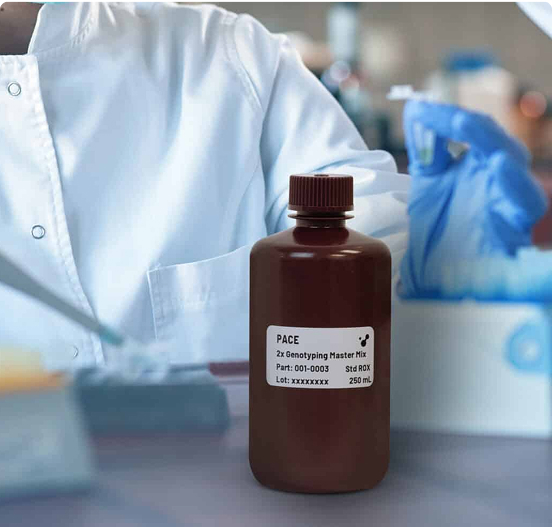
PACE GENOTYPING MASTER MIX
2. DESCRIPTION
PACE (PCR Allelic Competitive Extension) genotyping chemistry is a homogeneous, PCR-based allelespecific technology for the analysis of Single Nucleotide Polymorphisms (SNPs) and insertion/deletions (Indels).
The PACE genotyping chemistry is comprised of two parts:
- PACE Genotyping Assay: comprising two allele-specific forward primers and one common, reverse
primer. - PACE Genotyping Master Mix: containing all components required for PCR and generation of fluorescent signals.
When combined with template DNA, these components create a PACE Genotyping Reaction.

3. STORAGE AND SHELF LIFE
PACE Genotyping Master Mix is shipped on blue ice. Upon arrival, store at -20˚C/-80˚C (stable for two years); multiple freeze/thaw cycles are not recommended. PACE Genotyping Master Mix can be aliquoted into light-protective tubes to reduce the need for repeated freeze-thaw cycles. The mix can also be stored at 4˚C for two weeks (protected from light).
4. SAFETY WARNINGS AND PRECAUTIONS
This product should only be handled by trained laboratory personnel. It is advisable to wear suitable personal protective equipment (PPE) when using the product. In case of contact with skin or eyes, wash immediately with water.
5. KIT COMPONENTS
PACE Genotyping Master Mix (supplied at 2x concentration), containing a specifically engineered Taq polymerase, universal fluorescent reporting cassette, dNTPs, buffer, performance enhancers, MgCl2 at 4.4 mM (2.2 mM at 1x concentration) and the passive reference dye (ROX).
REQUIRED COMPONENTS
- Fluorescent plate reader or qPCR machine capable of reading the fluorophores in Table 1
- PCR plate or equivalent and appropriate optically-clear seal
- Template DNA
- PCR-grade water
- Genotyping assays (see section 8).
| FLUOROPHORE | EXCITATION (nM) | EMISSION (nM) |
| FAM | 485 | 520 |
| HEX | 520 | 560 |
| ROX * | 580 | 610 |
* Only required where appropriate.
6. ROX COMPATIBILITY
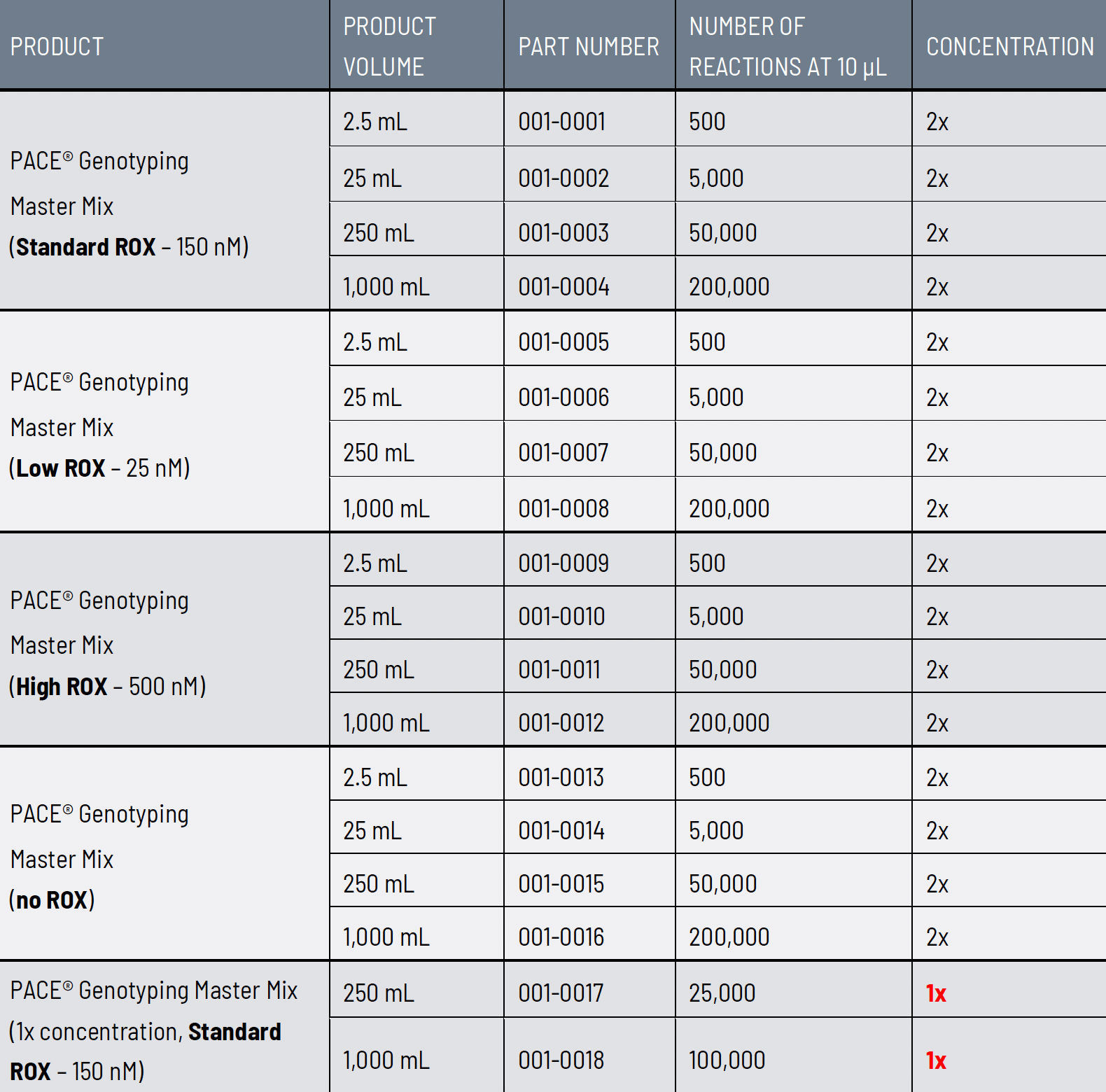
PACE Genotyping Master Mix is supplied without ROX, or with standard, low or high ROX levels. Please ensure compatibility between the ROX level of the master mix and the qPCR instrument; should you require further assistance, please contact the manufacturer of your qPCR instrument or plate reader or contact 3CR Bioscience’s Technical Support team.
If a fluorescent plate reader is used instead of a qPCR instrument, it is recommended that the standard ROX version of the PACE Genotyping Master Mix is used.
7. MECHANISM OF ACTION
Here is a video explaining PACE genotyping chemistry mechanism of action:
PACE genotyping chemistry uses a novel, universal, fluorescent reporting cassette to produce machinereadable fluorescent signals corresponding to genotypes. A PACE Genotyping Assay is comprised of two competitive allele-specific forward primers (which differ in their terminal 3’ bases and unique 5’ tail sequences) and a common, reverse primer. The PACE Genotyping Master Mix contains a quenched fluorescent reporting cassette for the fluorophores FAM and HEX.
When PCR is initiated, the allele-specific primers bind with their 3’ ends at the SNP of interest. Both allelespecific primers will bind if the SNP is heterozygous, whereas only one or other of the primers will bind if the SNP is homozygous. At the same time, the common reverse primer will bind on the opposite strand.
As PCR proceeds, the tail sequences of allele-specific forward primers become incorporated into the amplicon and the corresponding tail sequence complement is generated. At this point the quenched, fluorescent reporting cassettes bind to their appropriate tail sequence complements, becoming unquenched and producing a light signal. If the genotype of the SNP is homozygous, only one of the possible fluorescent signals will be generated, whereas if the SNP is heterozygous, the result will be a mixed fluorescent signal.
8. GENOTYPING ASSAYS
PACE Genotyping Assay designs are available using our complimentary assay design service at www.3crbio.com.
Pre-existing KASP™ and Amplifluor® assays can also be used in conjunction with the PACE genotyping chemistry. Table 2 shows how to a PACE Genotyping Assay for genotyping from the constituent primers.
| PRIMER | FINAL CONCENTRATION (μM) | VOL REQUIRED FOR 100 μL PACE ASSAY (μL) |
| Allele-specific primer 1 – FAM sequence tail (100 μM) | 12 | 12 |
| Allele-specific primer 2 – HEX sequence tail (100 μM) | 12 | 12 |
| Common, reverse primer (100 μM) | 30 | 30 |
| PCR-grade water | – | 46 |
| Total | – | 100 |
9. DNA QUALITY AND QUANTITY
It is recommended to use 1-10 ng of gDNA per reaction well, though this will vary with organism genome size (large genomes will require a proportionately larger DNA mass). For optimal results, purified and wellnormalised DNA samples should be used. However, when using PACE reagents in high throughput, purified DNA is often not commercially practical. DNA that has been crudely extracted works particularly well with PACE reagents, but such samples should be tested before commencing large scale work. Empirical optimisation of DNA concentration by testing a sample dilution range test is the most sensible approach.
Testing is particularly important when using crude lysates as these may contain inhibitory substances at concentrations that are too high for the mix formulation to tolerate. In this case the optimal concentration will be where the level of any sample-derived inhibitors is sufficiently reduced to allow PCR to proceed. In some rare cases, the DNA concentration remaining at this dilution point can be too low for PCR to proceed, in which case the samples should be purified. Where PCR inhibitors are causing an issue, PACE 2.0 Genotyping Master Mix should be tested. If DNA samples contain EDTA, the concentration at the final reaction concentration should be no higher than 0.1 mM.
10. CONTROLS
To improve confidence in the genotyping data, control samples should be used on the PCR plate in addition to the test samples. Negative controls (no-template controls, or NTCs) should always be used and consist of the same buffer used to hydrate the DNA samples, dispensed into several wells of the PCR plate.
Positive controls can also be used, if available, and should consist of DNA samples of known genotype. When viewing the genotyping data, NTCs should show no amplification and remain around the origin of the cluster plot (see Figure 1), giving confidence that any amplification observed is real. Any amplification observed in the NTC wells would indicate contamination or non-specific amplification. The positive control samples should cluster in the expected regions for their genotype.
11. GENOTYPING PROCEDURE
A. ARRAYING TEMPLATE DNA
A liquid-handling system appropriate to the number of DNA samples to array should be used. DNA samples can also be arrayed manually if working with a low number of samples.
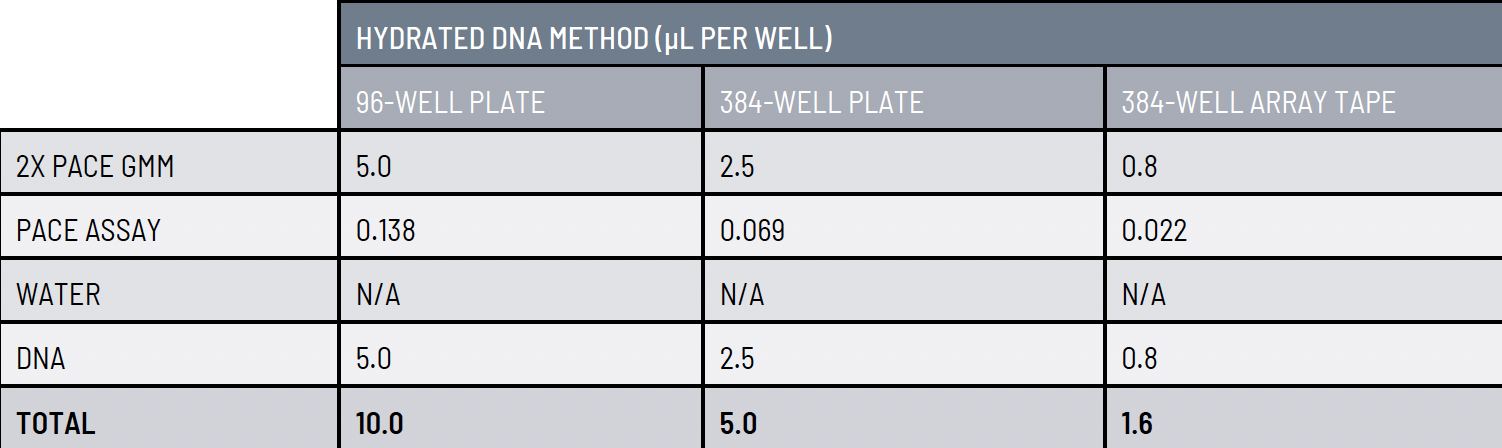
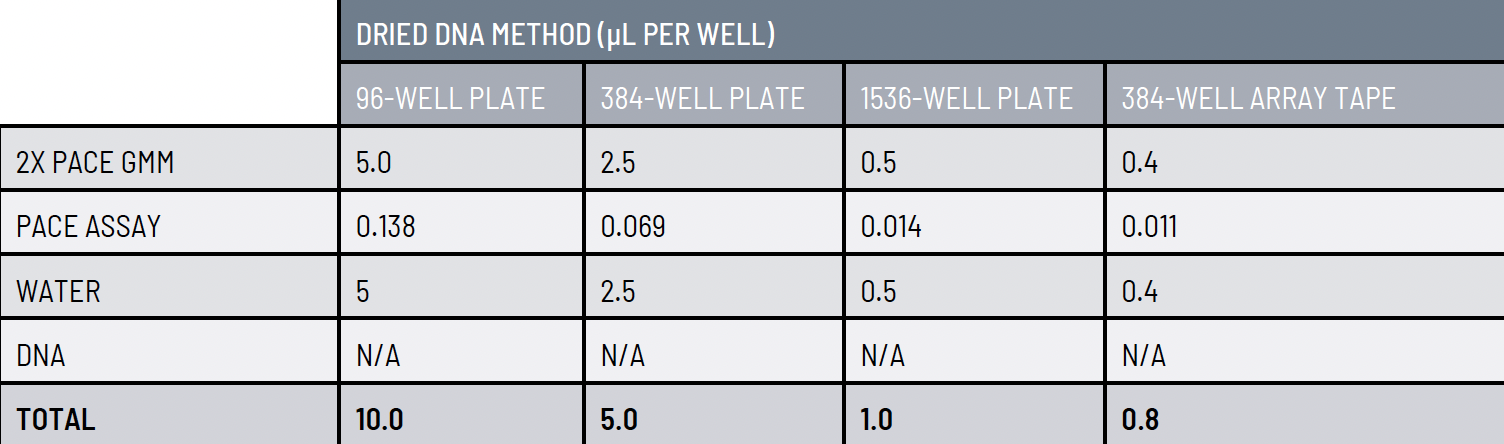
PACE Genotyping Master Mix can be used with hydrated (Table 3) or dry (Table 4) DNA samples. Both approaches work equally well but have practical advantages and disadvantages. If low numbers of samples are to be genotyped, it is not worth drying the DNA samples. However, if high numbers of samples are to be genotyped in one run, then drying the DNA samples can improve the resulting genotyping data. Hydrated DNA arrayed in a PCR plate will quickly begin to evaporate differentially across the plate (samples near the edges evaporate more quickly than those in the middle). Variation in DNA volumes across the plate will lead to variation in the final reaction concentrations, causing sub-optimal genotyping results. For this reason, when drying the DNA into the plate wells the user must ensure that the DNA has been dried to completion. Dried DNA samples will be stable long term at ambient temperature.
If a very small reaction volume is to be used (for example 1.0 µL total volume), it might not be possible to accurately dispense 0.5 µL of DNA and 0.5 µL of total reaction mix. In this example, drying the sample would allow a more realistic 1.0 µL of total reaction mix to be dispensed into the well.To dry the DNA, once dispensed into a PCR plate, the plate should be centrifuged to ensure the samples are in the bottom of the wells and then placed in a laboratory fan oven for one hour at around 55˚C, or until the samples have visibly dried. When assembling the total reaction mix, water must be added in the correct proportion to account for the missing volume of the DNA template. See Table 4 for details.
B. PACE GENOTYPING REACTION ASSEMBLY
PACE Genotyping Master Mix can be used with any reaction plate or well volume; it is not necessary to use a different product depending on reaction volume. It is very important that PACE Genotyping Master Mix is used at a final 1x concentration. However, the exception to this is in the PACE Genotyping Assay volumes shown in Tables 3 & 4. Here, the assay volume is ignored as it does not cause any functionally meaningful dilution and doesn’t affect the performance.
C. PACE GENOTYPING REACTION DISPENSING & PLATE SEALING
The PACE Genotyping Reaction must now be dispensed into the PCR plate wells. As with DNA dispensing, use a liquid handling system that is appropriate to the scale of the work. Once the PACE Genotyping Reaction has been dispensed, the PCR plate must be sealed with an optically clear seal and centrifuged to ensure all components are at the bottom of the wells.
D. THERMAL CYCLING
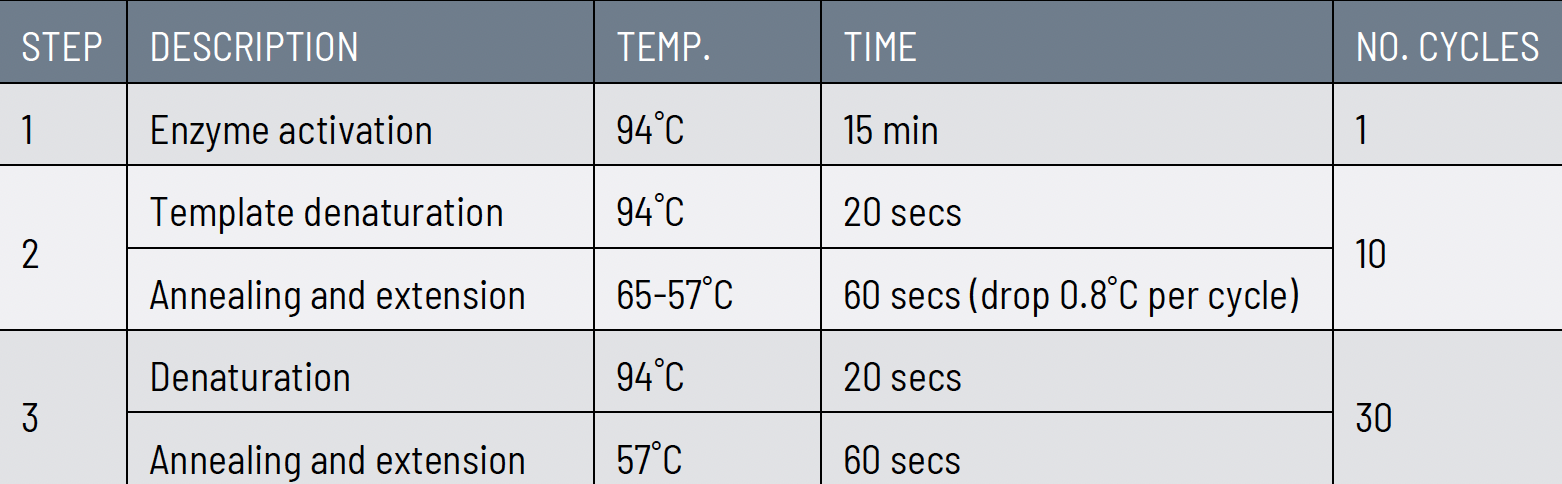
The PACE Genotyping Reactions must be thermally cycled according to the protocol described in Table 5.

E. FLUORESCENT SIGNAL DETECTION
After thermal cycling is complete, the fluorescent signal data should be collected using an appropriate fluorescent plate reader or qPCR machine in endpoint mode.
If the genotype clusters are not sufficiently defined after running the initial thermal cycling protocol, the plate should be cycled for an additional three cycles (see Table 6) then the fluorescent signal data collected again. The additional cycling/data analysis can be repeated until tight and well-separated clusters are observed, however it is recommended that this step is repeated a maximum of four times.
It is important that the fluorescent signal is read at or below 40˚C. If using a qPCR instrument, an additional temperature-controlled reading step should be included after the final PCR step or used separately to it. The temperature-controlled reading step should be used with both the main PCR (as described in Table 5) and with any subsequent additional cycling steps (Table 6). If using a fluorescent plate reader, the addition of this temperature-controlled reading step to the thermal cycling protocol should not be necessary as the PCR plate will have cooled sufficiently by the plate-reading stage.
F. INTERPRETATION OF DATA
The HEX and FAM florescence signal data produced by PACE Genotyping Reactions should be analysed and interpreted as a cluster plot using cluster analysis software or with Microsoft Excel (see Figure 1).
ROX passive reference dye can also be used to eliminate the effect of well-to-well liquid volume differences from the resulting cluster plot data. The inclusion of a passive reference leads to tighter clustering and, as a result, more accurate scoring of data.
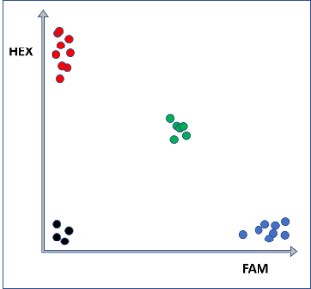
Figure 1. Diagram of typical genotyping cluster plot data generated from a PACE Genotyping Reaction. Black samples at the origin are the no-template controls (NTCs)
12. ORDERING INFORMATION
For ordering details, please visit www.3crbio.com.
13. SUPPORT
If you require any support with the use of PACE Genotyping Master Mix or other 3CR Bioscience products, please contact our Technical Support team on support@3crbio.com.
14. LEGAL INFORMATION
For Research Use Only. Not for use in diagnostic procedures.
3CR Bioscience Ltd. disclaims all warranties with respect to this documentation.
The purchase of this product conveys to the purchaser the limited, non-transferable right to use the purchased amount of the product only to perform internal research for the sole benefit of the purchaser. No right to resell this product or any of its components is conveyed expressly or by implication. This product is for internal research purposes only and is not for use in commercial applications of any kind, including, without limitation, quality control and commercial services such as reporting the results of purchaser’s activities for a fee or other form of consideration.
KASP™ is a trademark of LGC Biosearch Technologies
Amplifluor® is a registered trademark of Merck KGaA
©2023 3CR Bioscience Ltd. All rights reserved. Intended for molecular biology applications. This product is
not intended for the diagnosis, prevention or treatment of a disease.