At the School of Integrative Plant Science, Cornell AgriTech, Geneva, NY, Professor Larry Smart and his team are pioneering the integration of molecular genetics into hemp (Cannabis sativa) breeding. Originally focused on willow genetics for bioenergy, the Smart Lab pivoted in 2017 to hemp—an emerging crop with remarkable diversity and rapidly evolving markets. Their research now focuses on understanding and improving traits such as:
- Cannabinoid profile
- Plant sex determination
- Flowering time and photoperiod sensitivity
- Seed size and plant architecture
- Disease and pest resistance (e.g. powdery mildew)
By combining commercial cultivar evaluation, segregating population development, SNP genotyping platforms, and high-throughput phenotyping, the team delivers improved cultivars designed to meet the needs of growers and industry.
The Role of SNP Genotyping in Hemp Breeding
Many key traits in hemp only appear late in development or under specific environments, complicating early selection. To address this, the Smart Lab applies single SNP genotyping, which enables them to:
- Select for traits early in the breeding cycle
- Determine allelic status for recessive loci
- Fine-map genes of interest
- Stack genes difficult to distinguish phenotypically
This approach accelerates breeding, reduces costs, and improves cultivar uniformity—critical for large-scale commercial hemp production.
PACE® Technology: A Practical Solution for Breeders
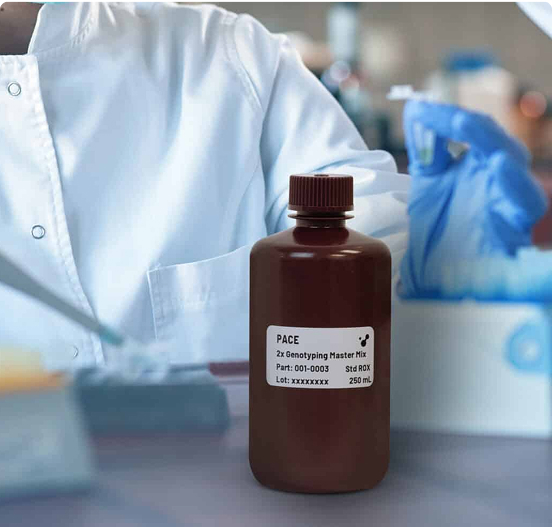
PACE is a robust, low-cost, high-throughput genotyping chemistry that is central to Cornell’s hemp program. With relatively low startup requirements — validated marker assays, scalable DNA extraction, and qPCR or fluorescent plate reader equipment — PACE is uniquely suited for applied breeding research.
Applications in Hemp Breeding
Early Sex Determination
- PACE assays distinguish male (XY) from female (XX) plants before flowering.
- Enables efficient management of breeding populations and crossing blocks.
“Supermale” Viability Testing
- Chromosome ratio assays revealed that YY plants are non-viable.
- Only XX and XY genotypes persist in populations derived from XY parents.
Flowering Time Genetics
- PACE markers allow early identification of homozygous and heterozygous states at major flowering loci.
- Supports development of uniform cultivars and earlier prediction of photoperiod sensitivity.
Chemotype Determination
- PACE assays replace slow, costly HPLC analysis, providing rapid and reliable identification of cannabinoid types.
- Ensures compliance with legal THC thresholds during breeding.
Case Study: Optimising the Bnull Marker
The Bnull haplotype, associated with chemotype IV plants, results from a 120 kb deletion of CBDAS at the B-locus. Traditional detection requires labour- intensive HPLC or gel-based assays. The Smart Lab have developed and optimised PACE assays to:
- Reliably detect the deletion with high specificity
- Enable marker-assisted selection (MAS) of over 1,500 seedlings
- Verify cannabinoid-null phenotypes with follow-up HPLC, confirming the absence of THCA and CBDA

Automation of Marker Assays
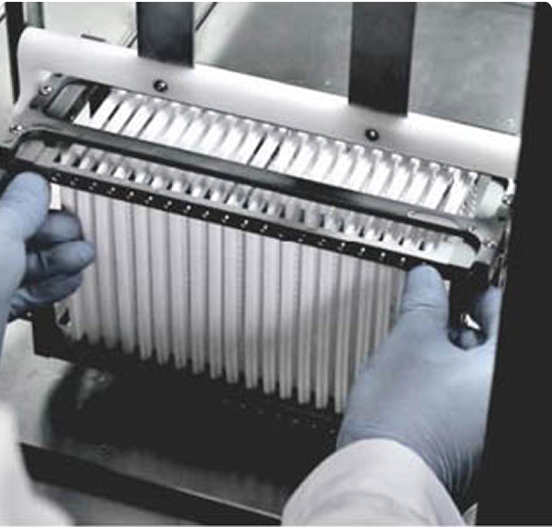
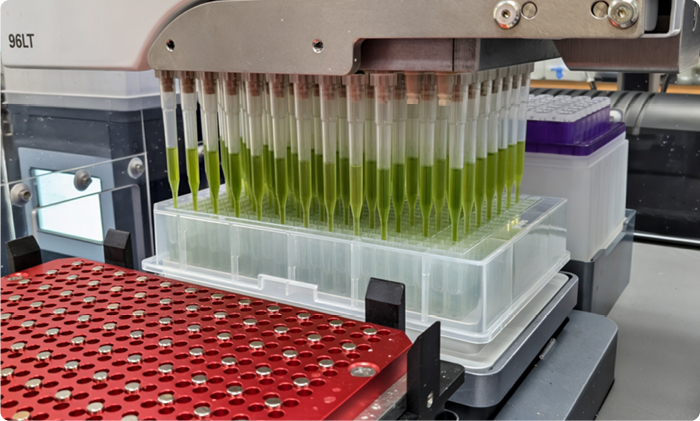
To further increase efficiency and consistency, the Smart Lab has automated key steps of the PACE genotyping workflow using an Agilent Bravo liquid- handling robot. The system performs both DNA extraction and PACE assay setup in 96- or 384-well plate formats. This automation enables high- throughput screening of over 3,000 samples per week—from seedling tissue collection to genotype calls—with minimal manual bench time. This expanded throughput enables the selection and scale-up of low-frequency alleles that would otherwise be too rare to capture and advance in breeding populations.
Getting Started with PACE®
Design:
Identify trait-linked SNPs or InDels and design primers using the universal 5′ tail system. The competitive primers should anchor the polymorphism at the 3′ end. The shared common primer should be free of any known polymorphisms.
Ideal binding site parameters:
- Tm = 57-65 °C
- GC-content = 40-60 %
- Product length = 60–120 bp

DNA Quality:
For hemp and most plant species, CTAB-extracted DNA provides reliable template quality. PACE assays are tolerant of moderate DNA quality variation, and crude preps can perform well provided that PCR inhibitors are minimised.
Instrumentation:
PACE reactions require a thermocycler and are compatible with qPCR systems or fluorescence plate readers capable of detecting FAM and HEX wavelengths.
Validation:
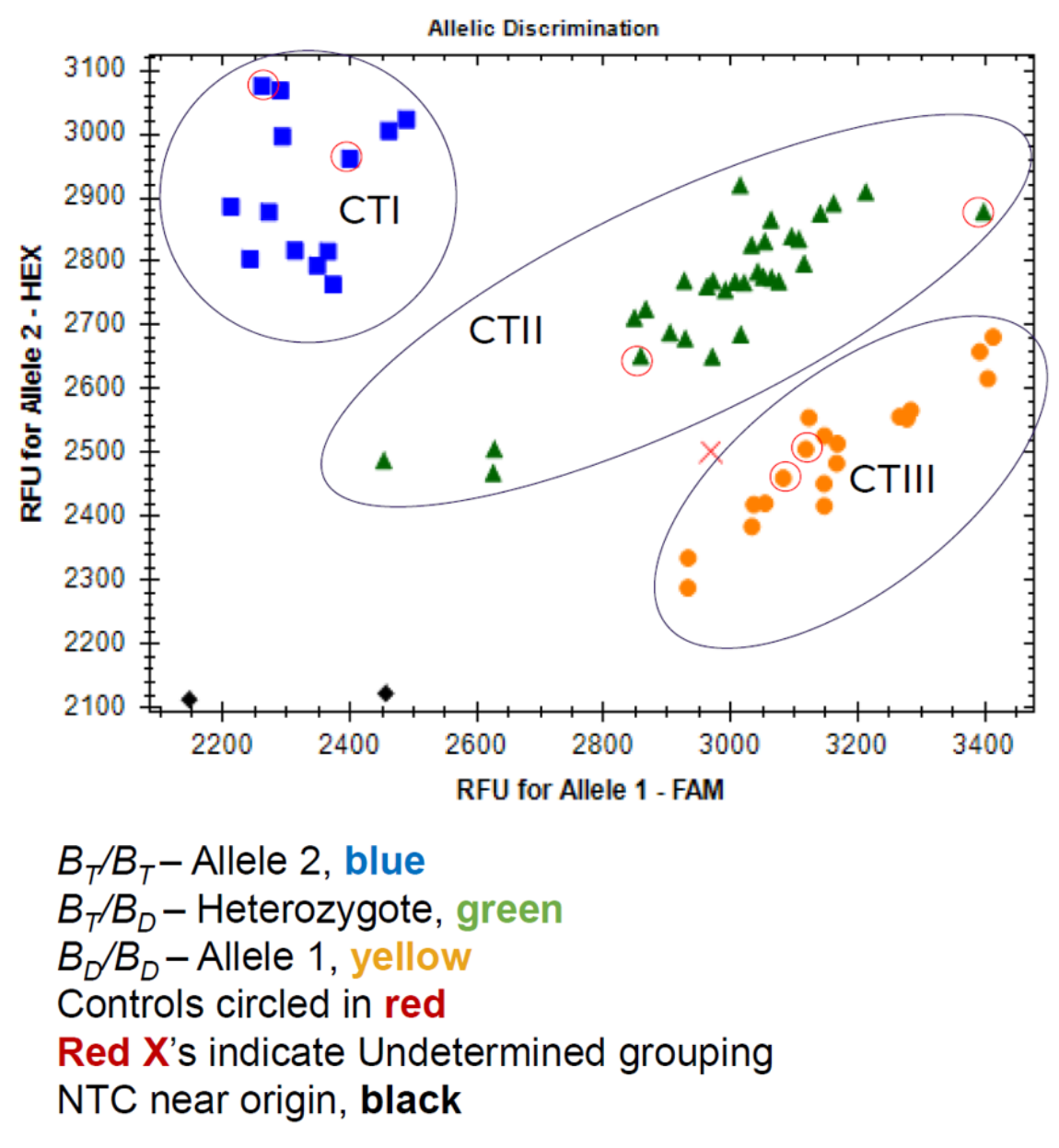
Validate each assay using known genotypes representing all three allelic configurations (homozygous reference, heterozygous, homozygous alternate) to confirm accurate clustering. Once validated, these samples can be retained as internal controls for future assay runs.

Validated Marker Portfolio
The Smart Lab has developed and validated a growing panel of molecular markers for hemp traits, which are available on their Cornell Hemp GitHub repository, including:
- Chemotype: Multiple assays distinguishing THCAS, CBDAS, and null alleles
- Flowering time: SNP and duplication events linked to day-neutral and early flowering phenotypes
- Sex determination: Diagnostic markers distinguishing XX vs. XY
- Disease resistance: Markers linked to powdery mildew susceptibility genes
- Pigmentation: Markers for purple leaves, stems, and flowers
This marker set, validated across diverse germplasm, enables reproducible high-throughput genotyping for both breeding and population-level surveys.

Benefits of PACE® for Hemp Breeding
The Smart Lab highlights several advantages of PACE genotyping across breeding programs:
- Clear, interpretable clustering of results
- Flexible scalability from hundreds to tens of thousands of samples
- Affordable implementation compared to alternative platforms
- Diagnostic-level accuracy across diverse populations
- Ease of new marker creation with the universal 5’ tail system

Future Directions
The Smart Lab continues to expand their genotyping toolkit with PACE technology, focusing on:
- Improving markers to diagnostic-level accuracy
- Developing new trait assays as genomic resources expand
- Multiplexing PACE assays to increase throughput and reduce costs further.
Conclusion
The hemp genetics program led by Professor Larry Smart at Cornell AgriTech is advancing plant breeding by integrating molecular genetics, high-throughput phenotyping, and PACE genotyping technology.
By enabling early, accurate, and affordable selection for critical traits—including sex, chemotype, flowering time, and disease resistance— PACE empowers breeders to shorten breeding cycles, cut costs, and deliver superior cultivars to market faster.
PACE has become a valuable tool in modern hemp breeding, supporting innovation in breeding programs worldwide.