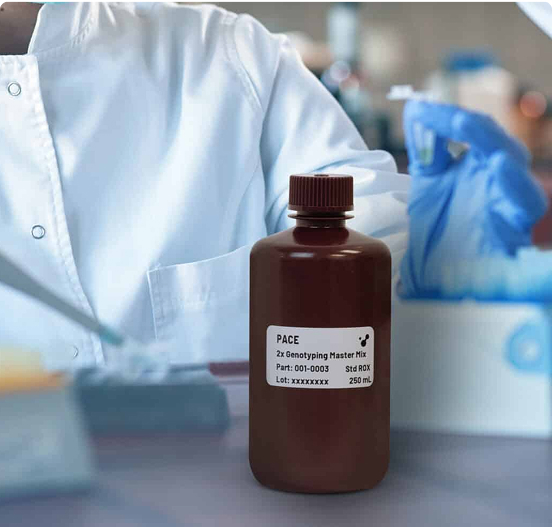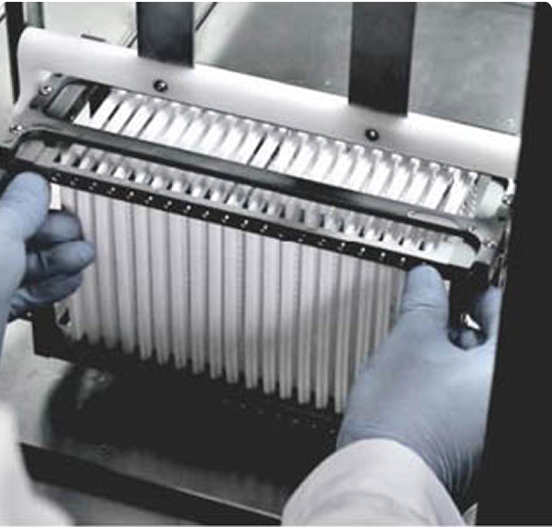
The Field Crop Development Centre at Olds College of Agriculture & Technology (FCDC), Alberta Canada, is a world-class research facility developing enhanced cereal varieties for feed, forage, malt, food and bio-industrial uses. The biotechnology laboratory at FCDC focuses on the application and development of molecular techniques to support variety development. Michael Holtz, Senior Research Associate, spoke to us about his group’s work with Barley and Triticale, and how PACE® genotyping has benefitted their marker development and trait development workflow.
What is your current research focus?
As a plant breeding organization, our focus is on developing varieties that meet the needs of producers and industry. Our research focuses on supporting that goal and most internal biotechnology research is focused on expanding the number of traits for which marker-assisted selection is utilized and introducing more modern selection methods, such as genomic selection, for identifying and integrating desirable traits into well-adapted germplasm.

How does SNP genotyping fit into your workflow?
We currently perform mostly marker-assisted selection (MAS) and marker-assisted gene pyramiding (MAGP). We use SNPs for QTL and marker discovery in genetic populations, for testing of markers reported by other research groups and for the routine genotyping of breeding lines to allow breeders to better select for traits of interest.
What are the challenges and benefits of working with Barley and Triticalale?

Triticale and Barley are important crops, particularly barley which is utilized as both livestock feed and a feedstock for the malting industry. That does result in challenges however as both the livestock and malting industries have differing quality targets resulting in divergent breeding goals that need to be realized. Triticale brings additional challenges as a hexaploid containing three genomes, two originating from wheat and the third from rye. In addition to the large and more complex genome, triticale receives less research funding and fewer genomic resources are available for the crop.
How do you use PACE®?
We use PACE for SNP genotyping. The primary use is to genotype breeding lines for SNPs known to be linked to or responsible for various economically relevant traits that are too time or labour-intensive to select by other methods.

What are the benefits of using PACE genotyping?
PACE benefits our work by allowing a single genotyping protocol and master mix that can be used with a variety of different markers without needing to worry about utilizing different reaction cycles or purchasing probes that are usable for only a single assay. Older legacy marker systems that necessitated gel electrophoresis have almost completely been replaced with PACE to avoid the time and labour required to run agarose gels and manually score those gels.