Genome-wide association studies (GWAS) and genotyping-by-sequencing (GBS) have transformed genetic research, enabling the discovery of thousands of SNPs and InDels linked to important traits across plant and animal populations. However, discovery is only the first step. To translate these findings into real-world breeding impact—whether improving crop yield, disease resistance, productivity, or animal performance—robust validation and scalable screening of these markers is essential.
Many breeding programs successfully identify promising markers through GWAS but face significant challenges when transitioning those discoveries into routine screening workflows. Sequencing-based validation can quickly become expensive, time-consuming, and difficult to scale across large breeding populations.
This is where PACE® genotyping technology, based on allele-specific PCR, plays a critical role—providing a practical, cost-effective solution for converting genomic discoveries into routine breeding decisions.
From Discovery to Application: The GWAS Bottleneck
GWAS generates vast datasets, identifying candidate markers associated with traits of interest. However, these markers must be:
- Validated across diverse populations
- Confirmed for accuracy and reproducibility
- Screened efficiently at scale within breeding pipelines
While sequencing technologies excel at marker discovery, they are not always practical for routine breeding operations where rapid turnaround, lower costs, and targeted marker panels are required.
Using sequencing-based approaches for this stage is often impractical. While powerful for discovery, next-generation sequencing (NGS) methods such as GBS can be:
- Costly when applied to routine screening
- Data-intensive and slow to analyse
- Inefficient for small to medium marker panels
- Dependent on complex bioinformatics workflows
For many breeding programs, this creates a gap between marker discovery and real-world implementation.
Breeding programs need a method that bridges the gap between discovery and deployment—delivering speed, accuracy, scalability, and cost-efficiency without adding unnecessary workflow complexity.
PACE®: Purpose-Built for Marker Validation and Screening
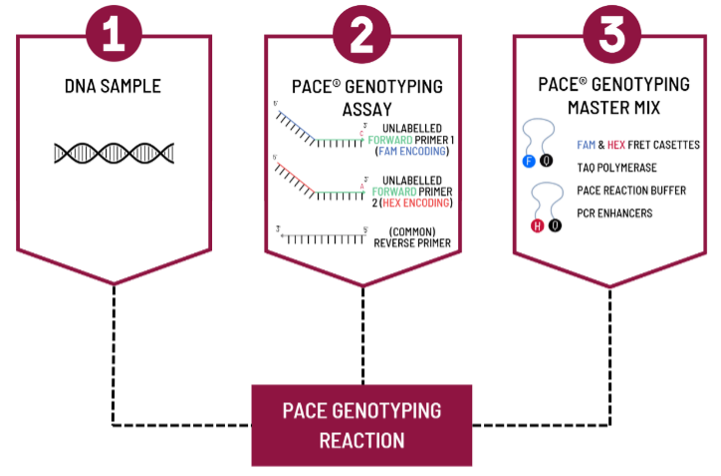
PACE® (PCR Allele Competitive Extension) genotyping offers a robust and scalable solution for SNP and InDel marker validation. Designed for flexibility and throughput, it is particularly well suited for the focused marker panels that emerge from GWAS studies.
Unlike sequencing workflows that require extensive data processing and specialist analysis, PACE® delivers straightforward allele calls that can be rapidly integrated into breeding decisions and marker-assisted selection programs.
Exceptional Accuracy and Specificity
PACE® leverages allele-specific PCR to discriminate between genetic variants with high precision. This ensures:
- Reliable differentiation of SNP alleles
- Consistent detection of InDels
- High-confidence confirmation of marker-trait associations
This level of specificity is essential when confirming GWAS findings and establishing reliable markers for downstream breeding applications.
By generating highly reproducible genotype data, PACE® helps researchers reduce false positives and make more confident selection decisions.
Proven Performance Across Species
PACE® technology is widely adopted across plant and animal breeding research, with numerous peer-reviewed studies demonstrating:
- High concordance with sequencing data
- Reproducible results across laboratories
- Robust performance across diverse genomes
PACE® chemistry is trusted across crop, livestock, horticulture, and aquaculture applications for reliable high-throughput SNP genotyping.
This track record gives researchers confidence when transitioning from discovery datasets to applied breeding workflows.

Scalable Throughput for Real-World Breeding
PACE® is ideally suited for genotyping anywhere from a handful to hundreds of markers across large sample sets. This makes it perfect for:
- Screening breeding populations
- Validating markers across environments
- Supporting marker-assisted selection (MAS)
- Enabling genomic selection workflows
Its compatibility with high-throughput workflows allows breeding programs to scale efficiently without compromising data quality or increasing operational complexity.
PACE® also helps reduce delays between marker discovery and breeding implementation, enabling faster selection cycles and more responsive breeding programs.
Cost-Effective Genotyping for Routine Screening
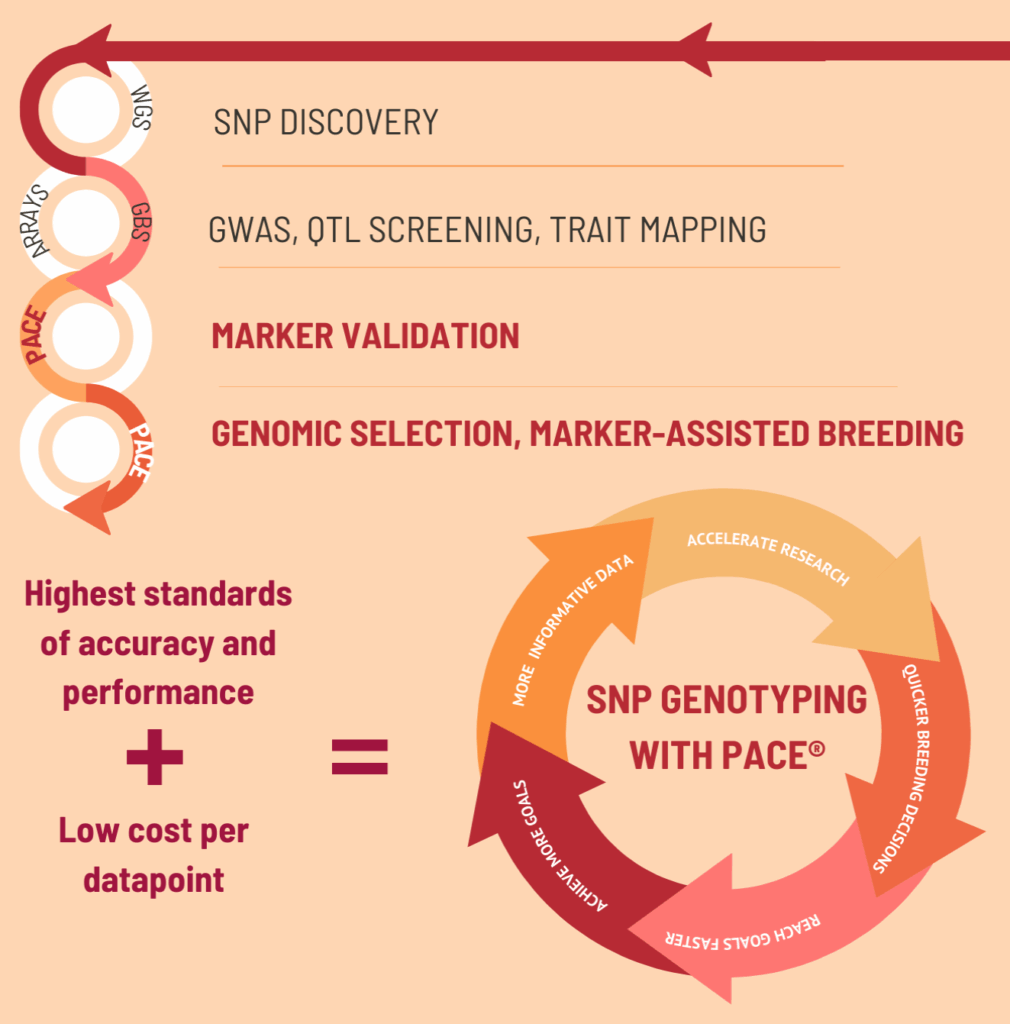
Compared to sequencing-based methods, PACE® significantly reduces per-sample and per-marker costs. This enables:
- Routine, large-scale screening
- More frequent testing cycles
- Better resource allocation within breeding programs
- Cost-effective deployment of targeted marker panels
For programs working with defined marker sets, this affordability makes routine molecular screening more commercially viable and operationally sustainable.
Lower genotyping costs also make it feasible to screen larger breeding populations more frequently, improving selection accuracy without inflating program budgets.
Aligned with 3CR’s mission of making science affordable, PACE® helps breeding programs implement high-quality genotyping at scale.
Flexibility and Custom Assay Design
One of PACE®’s key strengths is its adaptability. Researchers can design assays targeting specific SNPs or InDels identified through GWAS, allowing them to:
- Focus only on relevant markers
- Rapidly deploy new assays as discoveries emerge
- Tailor genotyping panels to specific traits or populations
This flexibility is critical in fast-moving research and breeding environments where new discoveries must be translated quickly into practical screening tools.
3CR also offers complimentary PACE® assay design support, helping researchers rapidly convert GWAS discoveries into deployable genotyping assays.
PACE® master mixes are fully compatible with PACE®, KASP™ and Amplifluor® assays, simplifying integration into existing workflows.
Explore how flexible PACE® assay design can simplify marker validation and routine screening in your breeding workflow.

Strengthening Marker-Trait Validation
Validating marker-trait associations is fundamental to successful breeding strategies. PACE® enables researchers to:
- Test markers across diverse germplasm
- Confirm robustness under different environmental conditions
- Eliminate false positives from GWAS datasets
- Generate consistent, reproducible genotype data
This improves confidence in marker performance and supports the development of reliable molecular breeding strategies.
For breeding teams moving discoveries into commercial pipelines, robust validation is essential for reducing risk and improving selection consistency.
Enabling Genomic Selection and Accelerated Breeding

Once validated, markers can be integrated into genomic selection models. PACE® provides the reliable genotypic data needed to:
- Improve prediction accuracy
- Estimate breeding values more effectively
- Accelerate selection cycles
- Support faster genetic gain
By enabling rapid, cost-effective screening, PACE® helps breeders make faster, data-driven decisions across breeding populations.
This is particularly valuable for breeding programs aiming to scale genomic selection without relying solely on sequencing-based workflows.
Why PACE® Stands Out
Rather than replacing sequencing technologies, PACE® complements them by providing a practical platform for routine marker validation and high-throughput screening.
It combines:
- The precision needed for validation
- The throughput required for large-scale screening
- The cost-efficiency essential for routine use
- The workflow simplicity needed for real-world breeding operations
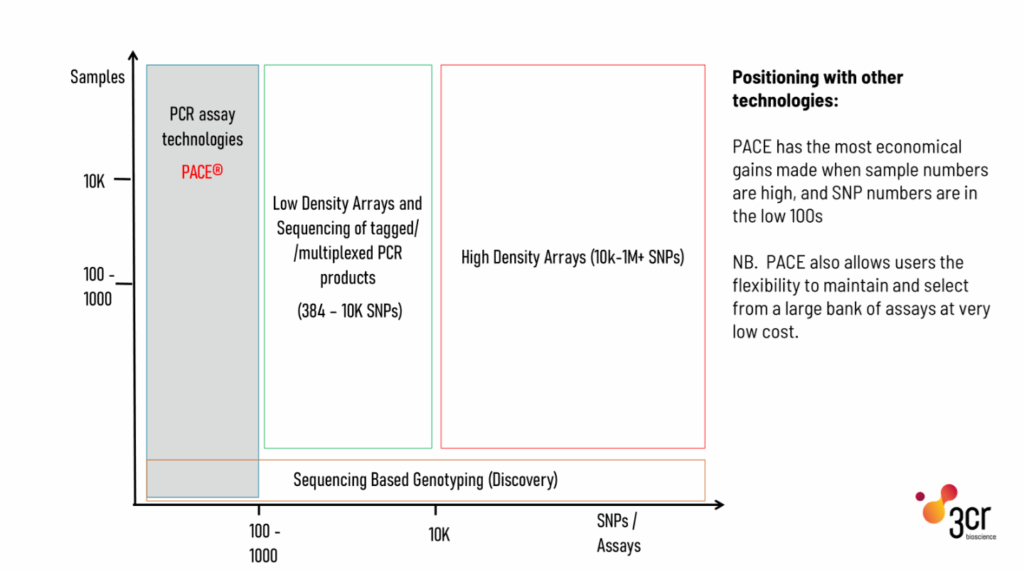
For breeding programs seeking to transition from genomic discovery into practical implementation, PACE® provides a scalable and commercially sustainable solution.
Move from genomic discovery to scalable breeding decisions with PACE® genotyping. Discover how 3CR helps breeding programs implement reliable, cost-effective marker screening workflows.
Conclusion
GWAS and sequencing technologies have unlocked unprecedented insights into genetic variation, but their true value lies in application. PACE® genotyping empowers researchers and breeders to validate, refine, and deploy these discoveries with confidence.
By offering a robust, flexible, and cost-effective platform for SNP and InDel genotyping, PACE® helps bridge the gap between genomic discovery and applied breeding.
Whether validating newly discovered GWAS markers or scaling routine breeding assays, PACE® enables breeding programs to implement molecular markers faster, more efficiently, and more affordably.
With flexible assay design, high-throughput compatibility, and proven performance across species, 3CR helps researchers turn genomic insights into measurable breeding progress—while continuing to make science affordable.