Genome editing technologies have transformed both agricultural and life sciences research, enabling scientists to make precise, targeted changes to DNA with unprecedented speed and accuracy. Among these technologies, CRISPR/Cas systems have become the dominant tool for editing genes, regulatory regions, untranslated regions, and intergenic sequences. As genome editing adoption accelerates, so too does the need for high-throughput PCR methods that can rapidly and reliably verify edits across large sample populations.
While high-throughput sequencing (HTS) remains a gold standard for detailed characterisation, it is not always the most efficient or cost-effective solution for early-stage screening. High-throughput PCR, particularly when combined with PACE® allele-specific genotyping, offers a powerful alternative for CRISPR screening and genome editing verification.
The Challenge of Screening CRISPR Gene Edits at Scale
CRISPR-mediated genome editing can generate a wide spectrum of genetic outcomes, including:
- Small or large insertions and deletions (indels)
- Single base-pair substitutions
- Frameshift mutations
- Gene knockouts
These edits are typically introduced through either Non-Homologous End Joining (NHEJ), which produces random mutations at the cut site, or Homology-Directed Repair (HDR), which enables precise, template-driven edits. In any genome editing experiment, researchers must efficiently distinguish successfully edited samples from wild-type material—often across hundreds or thousands of individuals.
Traditionally, sequencing has been used for this task. However, sequencing-based screening presents several limitations when applied at scale:
- High costs, particularly for large populations
- Stringent DNA purity requirements, increasing sample preparation time
- Data overload, requiring bioinformatics expertise to interpret large datasets
These challenges have driven demand for scalable, affordable, and rapid high-throughput PCR solutions that can act as a primary screening step before sequencing.
High-Throughput PCR with PACE® Allele-Specific Genotyping
PACE® (PCR Allele Competitive Extension) genotyping is a robust, high-throughput PCR technology designed to rapidly detect specific genetic variants with high accuracy. It is ideally suited for CRISPR screening and genome editing verification in both agricultural and life sciences research.
PACE genotyping uses competitive allele-specific primers and a universal fluorescent reporting system to distinguish edited alleles from wild-type sequences in a single PCR reaction. This approach enables fast, machine-readable genotype calls without any post-PCR processing.
Key Benefits of PACE-Based High-Throughput PCR
PACE genotyping addresses the limitations of sequencing by offering:
- Broad applicability: Compatible with plants, animals, tissue cultures, protoplasts, seeds, and single cells
- High efficiency: Detects SNPs, knockouts, and both small and large indels using simple, unlabelled primers
- Cost-effectiveness: Requires minimal DNA input and works with crude lysates and high-throughput extraction methods
- High accuracy: Allele-specific primers precisely discriminate between edited and wild-type sequences
- Scalability: Ideal for breeding programmes, large screening studies, and industrial-scale genotyping
- Ease of use: Combines amplification and fluorescence detection in one step
This makes PACE an ideal high-throughput PCR solution for researchers seeking to streamline CRISPR screening workflows.
CRISPR Gene Edit Detection Assays from 3CR Bioscience
3CR Bioscience’s CRISPR Gene Edit Detection Assays combine the power of PACE genotyping with custom assay design to deliver fast, affordable, and reliable high-throughput PCR screening of genome edits.
Our assays are designed using DNA sequences you provide, including the target site, spacer, and PAM. They can detect edits introduced via directed CRISPR editing or NHEJ, even when the exact mutation is unknown.
How the PACE CRISPR Detection Assay Works
- Assay design: Submit your target DNA sequence following our guidelines
- Assay delivery: Receive ready-to-use, pre-validated PACE CRISPR detection assays
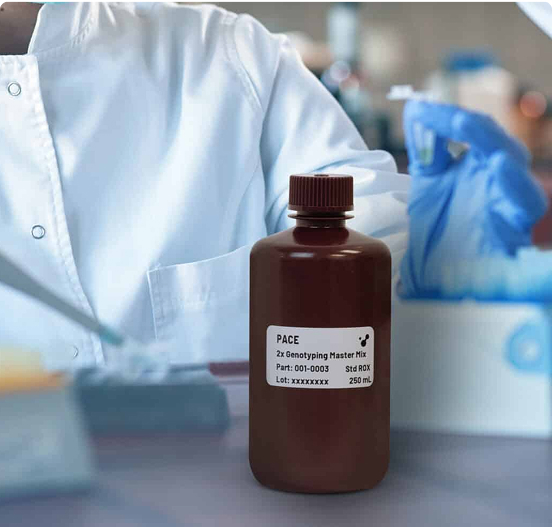
- Reaction setup: Assemble reactions using PACE assays and PACE Genotyping Master Mix
- Run and analyse: Perform PCR and rapidly identify edited samples via fluorescence
- Follow-up: Confirm selected samples by sequencing if required
Each order includes 400 µL of ready-to-use 72× PACE assay, sufficient for at least 2,800 reactions at a 10 µL volume. All assays are proprietary and confidential.

Spotlight: High-Throughput PCR in Plant Breeding
CRISPR/Cas systems are now central to modern plant breeding, enabling the development of crops with improved yield, resilience, and quality traits. High-throughput PCR using PACE genotyping supports plant breeding at every stage:
- Early detection of edits to optimise transformation protocols
- Bulk screening of seed or grain populations for trait purity
- Generation of robust data for regulatory submissions
- Monitoring genome edits in commercial products
PACE can detect all classes of edits, from single nucleotide changes (SDN1) to large rearrangements (SDN3), and can also be used to monitor potential off-target modifications.
Accelerating Genome Editing with High-Throughput PCR
High-throughput PCR has become an essential component of modern genome editing workflows. By offering a rapid, scalable, and cost-effective alternative to sequencing for primary screening, PACE® allele-specific genotyping empowers researchers to move faster and more efficiently.
Whether you are improving crop traits, developing edited cell lines, or optimising CRISPR protocols, 3CR Bioscience’s CRISPR Gene Edit Detection Assays provide the accuracy, speed, and scalability needed to transform your genome editing workflow.