1. PRODUCT DETAILS
2. DESCRIPTION
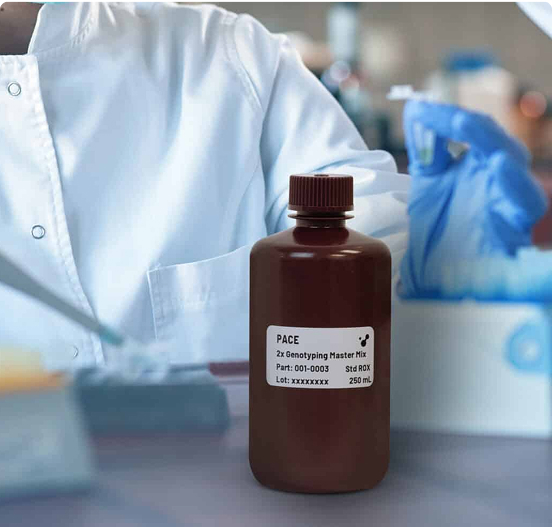
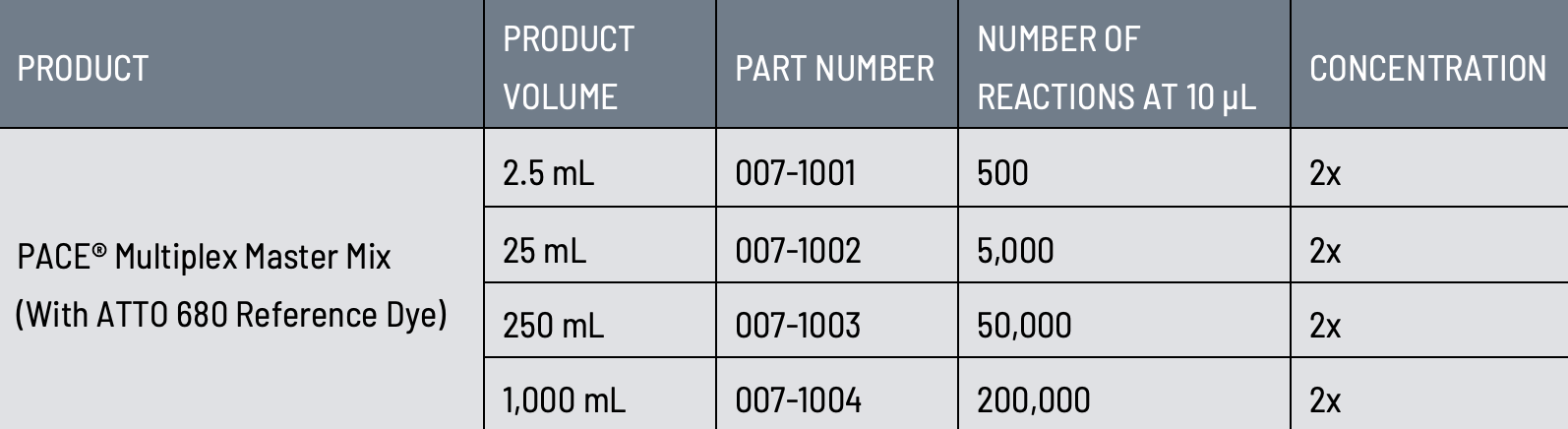
PACE Multiplex Master Mix is an advanced and versatile extension of our PACE 2.0 Genotyping Master Mix, formulated for the simultaneous detection of up to four targets in one reaction well. For example, two biallelic SNPs, or one reference gene and a further three genes of interest.
The PACE genotyping chemistry is comprised of two parts:
- PACE Genotyping Assay Mix: comprising two pairs of allele specific forward primers and two common, reverse primers for SNPs or Indels, or four pairs of primers for detecting genes of interest.
- PACE Multiplex Master Mix: containing all components required for PCR and generation of fluorescent signals.
When combined with template DNA, these components create a PACE Multiplex Genotyping Reaction.

3. STORAGE AND SHELF LIFE
PACE Multiplex Master Mix Trial Kit is shipped on blue ice. Upon arrival, store at -20˚C/-80˚C (stable for two years); multiple freeze/thaw cycles are not recommended. The kit can also be stored at 4˚C for two weeks (protected from light).
4. SAFETY WARNINGS AND PRECAUTIONS
This product should only be handled by trained laboratory personnel. It is advisable to wear suitable personal protective equipment (PPE) when using the product. In case of contact with skin or eyes, wash immediately with water.
5. KIT COMPONENTS
- PACE Multiplex Master Mix: A single tube (500 µL) of PACE Multiplex Master Mix (supplied at 2x concentration), containing the passive reference dye, ATTO 680.
- Trial DNA samples: Three DNA tubes, each containing 50 µL DNA at the correct working concentration (no need to dilute):
- DNA 1 (blue lid)
- DNA 2 (green lid)
- DNA 3 (red lid)
- PACE Multiplex Genotyping Assay Mix: A single tube (20 µL) with a mixture of two PACE Genotyping
Assays:- PACE Genotyping Assay 1 reporting with FAM and HEX
- PACE Genotyping Assay 2 reporting with ATTO 590 and ATTO 647N
ADDITIONAL COMPONENTS REQUIRED
- Fluorescent plate reader or qPCR machine capable of reading the fluorophores in Table 1
- PCR plate or equivalent and appropriate optically clear seal
- PCR-grade water
6. REFERENCE DYE
In this trial kit, PACE Multiplex Master Mix is supplied with a passive reference dye, ATTO 680 added. Please check your instrument for reference dye compatibility (see Table 4); should you require further assistance, please contact the manufacturer of your qPCR instrument or plate reader or contact 3CR Bioscience’s Technical Support team.
7. MECHANISM OF ACTION
PACE Multiplex Master Mix uses a novel, universal, fluorescent reporting cassette to produce machinereadable fluorescent signal. The master mix contains four universal quenched fluorescent reporting cassettes, labelled with the fluorophores FAM, HEX, ATTO 590 and ATTO 647N.
For this trial kit, two SNP genotyping assays are included, each comprised of two competitive allele specific forward primers (which differ in their terminal 3’ bases and unique 5’ tail sequences), and a common reverse primer. PACE Genotyping Assay 1 is designed to report with FAM and HEX, whilst PACE Genotyping Assay 2 is designed to report with ATTO 590 and ATTO 647N.
When PCR is initiated, the allele-specific primers bind with their 3’ ends at the SNP of interest. Both allelespecific primers will bind if the SNP is heterozygous, whereas only one or other of the primers will bind if the SNP is homozygous. At the same time, the common reverse primer will bind on the opposite strand.
As PCR proceeds, the tail sequences of allele-specific forward primers become incorporated into the amplicon and the corresponding tail sequence complement is generated. At this point the quenched, fluorescent reporting cassettes bind to their appropriate tail sequence complements, becoming unquenched and producing a light signal. If the genotype of the SNP is homozygous, only one of the possible fluorescent signals will be generated, whereas if the SNP is heterozygous, the result will be a mixed fluorescent signal.
8. REACTION PROCEDURE
A. SUMMARY
- Dispense each of the DNA samples in triplicate into a PCR plate using suggested volumes in Table 1.
- In a separate tube, combine the recommended volume of PACE Multiplex Master Mix and PACE Genotyping Assay Mix as shown in Table 2.
- Mix well, then dispense the combined reaction mix into all 12 sample wells containing DNA samples plus no template controls. Spin, seal, then run the plate using the recommended thermal cycling conditions given in Table 3.
- Read the plate and compare with expected results.
| VOLUME PER WELL 96-WELL PLATE | VOLUME PER WELL 384-WELL PLATE | VOLUME PER WELL 1536-WELL PLATE | |
| DNA 1 (blue lid) | 5 µL | 2.5 µL | 1.5 µL |
| DNA 2 (green lid) | 5 µL | 2.5 µL | 1.5 µL |
| DNA 3 (red lid) | 5 µL | 2.5 µL | 1.5 µL |
| PCR-grade water (No template control) | 5 µL | 2.5 µL | 1.5 µL |
| 96-WELL PLATE | 384-WELL PLATE | 1536-WELL PLATE | ||
| 1 | PACE Multiplex Master Mix | 65.0 µL | 32.5 µL | 13 µL |
| 2 | PACE Genotyping Assay Mix | 1.8 µL | 0.9 µL | 0.36 µL |
| Total | 66.8 µL | 33.4 µL | 13.36 µL | |
| 3 | Volume of this Reaction Mix added to each of the 12 test wells | 5.0 µL | 2.5 µL | 1 µL |
B. STEP-BY-STEP GUIDE
Step 1. Dispense each of the three trial DNA samples (DNA 1, 2 and 3) in triplicate onto a PCR plate using volumes given in Table 1.
Step 2. Combine appropriate volumes of PACE Multiplex Master Mix with PACE Genotyping Assay mix in a tube, as detailed in Table 2, mix.
Step 3. Dispense the combined mixtures into each of the wells containing DNA using volumes indicated in table. Each test now contains a complete PACE Multiplex genotyping reaction.
Step 4. Seal the PCR plate with an optically clear seal and centrifuge to ensure all components are at the bottom of the wells.
Step 5. Thermally cycle the reaction plate using the thermal cycling conditions in Table 3.
| STEP | DESCRIPTION | TEMP. | TIME | NO. CYCLES |
| 1 | Enzyme activation | 94˚C | 15 min | 1 |
| 2 | Template denaturation | 94˚C | 20 secs | 10 |
| 2 | Annealing and extension | 65-57˚C | 60 secs (drop 0.8˚C per cycle) | 10 |
| 3 | Denaturation | 94˚C | 20 secs | 30 |
| 3 | Annealing and extension | 57˚C | 60 secs | 30 |
C. FLUORESCENT SIGNAL DETECTION
After thermal cycling is complete, the fluorescent signal data should be collected using an appropriate fluorescent plate reader or qPCR machine in endpoint mode. Table 4 details the optimal suggested wavelength and bandwidth settings for each filter to minimise crosstalk between the different filters.
| FLUOROPHORE | EXCITATION (nM) | EMISSION (nM) |
| FAM | 485 (10 nM) | 520 (10 nM) |
| HEX | 520 (10 nM) | 560 (10 nM) |
| ATTO 590 | 590 (10 nM) | 620 (10 nM) |
| ATTO 647N | 635 (10 nM) | 670 (10 nM) |
| ATTO 680 Reference Dye | 675 (10 nM) | 705 (10 nM) |
It is important that the fluorescent signal is read at or below 40˚C. If using a qPCR instrument, an additional temperature-controlled reading step should be included after the final PCR step or used separately to it. The temperature-controlled reading step should be used with the main PCR (Table 3). If using a fluorescent plate reader, the addition of this temperature-controlled reading step to the thermal cycling protocol should not be necessary as the PCR plate will have cooled sufficiently by the plate-reading stage.
D. INTERPRETATION OF DATA
The HEX, FAM, ATTO 590, and ATTO 647N florescence signal data produced by PACE Multiplex Genotyping Reactions should be analysed and interpreted as cluster plots using cluster analysis software or with Microsoft Excel (see Figure 1).The ATTO 680 passive reference dye is included to eliminate the effect of wellto-well liquid volume differences from the resulting cluster plot data. This inclusion leads to tighter clustering and, as a result, more accurate scoring of data.
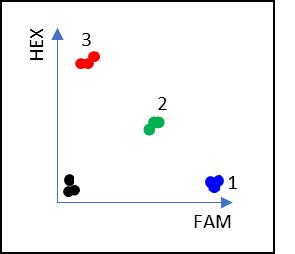
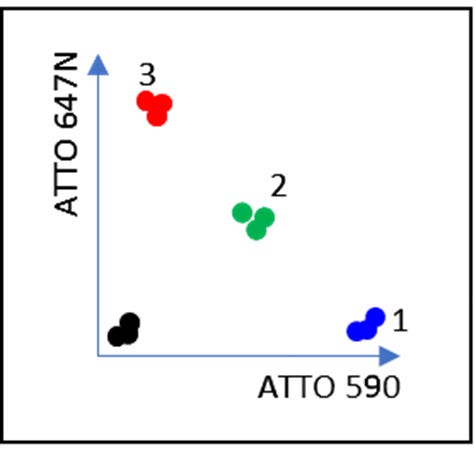
Figure 1. Diagram of typical genotyping cluster plot data generated from a PACE Multiplex Genotyping Reaction. Black samples at the origin are the no-template controls (NTCs).
9. ORDERING INFORMATION
For ordering details, please visit www.3crbio.com.
10. SUPPORT
If you require any support with the use of PACE Multiplex Master Mix or other 3CR Bioscience products, please contact our Technical Support team on support@3crbio.com.
11. LEGAL INFORMATION
For Research Use Only. Not for use in diagnostic procedures.
3CR Bioscience Ltd. disclaims all warranties with respect to this documentation.
The purchase of this product conveys to the purchaser the limited, non-transferable right to use the purchased amount of the product only to perform internal research for the sole benefit of the purchaser. No right to resell this product or any of its components is conveyed expressly or by implication. This product is for internal research purposes only and is not for use in commercial applications of any kind, including, without limitation, quality control and commercial services such as reporting the results of purchaser’s activities for a fee or other form of consideration.
©2024 3CR Bioscience Ltd. All rights reserved. Intended for molecular biology applications. This product is
not intended for the diagnosis, prevention or treatment of a disease.