Blog

Understanding the genetics of important traits in hemp to help breed improved cultivars

Understanding the genetics of important traits in hemp to help breed improved cultivars

Dr Jacob Toth is a Plant Breeding and Genetics Post-Doc at the School of Integrated Plant
Science at Cornell University, working in the research group of Professor Larry Smart. We
recently spoke with Jacob to find out more about the group’s research and how they are using
PACE® in their workflow.

What is your current research focus?

“Our lab investigates the genetics of important traits and uses these insights to breed new cultivars. Until 2018 the primary focus of the research group was investigating the genetic basis of traits relevant to willow breeding for bioenergy, but the focus of the lab has since switched to mainly studying hemp genetics. In hemp, important traits include cannabinoid type and content, plant sex, flowering time, seed size, plant colour and architecture, and resistance to pests and pathogens such as powdery mildew. To this end, we evaluate commercial cultivars, develop genotyping assays and platforms, develop segregating crosses that we genotype and phenotype, and are developing highthroughput methods for phenotyping.”

How does SNP genotyping fit into your research/workflow?

“The main use of single SNP genotyping in our plant breeding workflow is for early selection or determination of essentially qualitative traits that are usually only expressed at maturity or under certain conditions. Beyond that, we also use single SNP genotyping for determination of allelic status for recessive loci, for fine mapping genes, and for stacking genes difficult to distinguish phenotypically.”

Dr Jacob Toth, School of Integrated Plant Science, Cornell University

How do you use PACE?

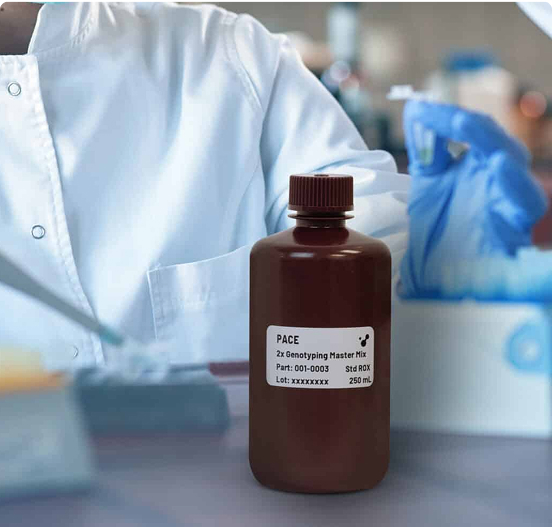
“We develop PACE assays based on interesting or informative SNPs or indels and use them for breeding and research purposes. We generally use PACE assays in 96-well PCR plates with an optically clear cover in 10 μL reactions. We generally run the samples on a Biorad C1000 Touch Thermocyler and read them in on a Biorad CFX96 real-time system. We then usually do analysis of the reads using CFX Maestro”.

How does PACE benefit your work?

“There are several qualitative traits in hemp that have a simple genetic basis but are difficult to assay. For instance, cannabinoid type is a major issue for hemp breeding, as if high-THC plants are grown, the crop is considered marijuana and not permitted to enter commerce. The standard way to assess chemotype is through HPLC analysis, which is slow and expensive. The cannabinoid type is largely governed by a single locus, and with PACE assays, we can screen thousands of plants for chemotype in a timeline of days rather than months using HPLC, and at a fraction of the cost.

There are also several major flowering time genes in hemp, but some are recessive. With PACE screening, we can identify homozygotes and heterozygotes resulting in a more uniform cultivar not segregating for these major genes. Knowing allelic states can also inform us about flowering time when the plant is young, rather than waiting months to see flowering under field conditions. We have also used PACE assays to show that there are at least two distinct loci conferring photoperiod insensitivity in hemp by crossing representative individuals and tracking the loci with PACE assays.

We also use PACE assays to determine the sex of young plants. This trait (male, XY, vs female, XX) is usually not expressed until the plant is mature, but with PACE assays we can separate out males from females at a young age, allowing us to manage crossing blocks in a more effective manner. We have also used PACE assays to determine if “supermale” (YY) plants are viable. We designed PACE assays that look at the ratio of X chromosomes to Y chromosomes and were able to collect seed off of XY plants that are normally male. Using PACE assays, we saw that there were only XX and XY plants in the XY-derived plants, with no YY group as determined by the marker.”

What are your research aims in the future?

“From a genetics standpoint, we are investigating seed size (remarkably, we have seen thousand seed weights vary from 8-60 grams!), plant color, minor cannabinoid production, late flowering genes, and plant sex determination. We hope to release grain and fiber cultivars with improved cannabinoid profiles better adapted to more southern latitudes in the near future, as well as develop equatorially adapted high-cannabinoid cultivars.”

What are the benefits and challenges of working with hemp?

“Hemp is a wonderfully diverse crop. We have plants that grow 16 feet tall in a season, plants that flower when they are 2 weeks old, and plants whose aroma ranges from gasoline to cherries. With the only very recent legalization of hemp, there is much to learn to bring it into 21st century cropping systems and being able to quickly and inexpensively determine the allelic state of major genes (which might determine market class) is a huge boon. The newness of the crop does bring its own challenges however, as markets are tumultuous, and legislation is inconsistent in the legality of the crop and its resultant products. On more practical notes, hemp is somewhat challenging to work with given its dioecious nature making desired crosses more difficult and inbreds less viable. The passion of the people working with hemp or Cannabis more broadly is a bit of a double-edged sword in that people get excited about the science and the plant in a way that you don’t see for other crops, but there are a lot of strong personalities and misinformation available online leading to obfuscation and questionable practices.”

MORE POSTS

Automated Pipetting vs. Manual Pipetting: Which Is Right for Your Lab?
Discover when manual pipetting is enough—and why automated pipetting with 3CR’s GeneArrayer and PACE® genotyping delivers superior speed, accuracy, and scalability.
High-Throughput PCR in CRISPR Screening and Genome Editing Verification
Discover how high-throughput PCR using PACE® genotyping accelerates CRISPR screening and genome editing verification across large sample populations.
Understanding the genetics of important traits in hemp to help breed improved cultivars
Learn how Cornell University uses PACE® SNP genotyping to accelerate hemp breeding—enabling early trait selection, sex determination, and cost-effective genetic screening.

Our product portfolio for your PCR genotyping workflow

Our portfolio of products and services include PACE® genotyping chemistry, instruments, and lab services to streamline every step of your workflow. Designed for life sciences, biotech, and agricultural research, our high-performance reagents, reliable instruments, and expert lab support help you achieve accurate, consistent results while reducing time and costs – making science affordable.

[fibosearch]
This field is for validation purposes and should be left unchanged.
Name(Required)

Contact us

Stay up to date with all things 3CR. 

Sign up now to receive insights, updates 
and industry case studies. 

MEET OUR TEAM

Steve AsquithManaging Director
Steve began his career in the Genetics Division of GlaxoSmithKline, as part of the team establishing GSK’s high-throughput core genotyping laboratory. Steve joined KBioscience when it was first founded in 2002 and was a key driver in taking the company from a small start-up to a multi-national service laboratory, quickly growing the company’s revenue to over $7.5M p.a. Following the acquisition of Kbioscience by LGC in 2011, Steve was appointed Global Director of Operations for LGC Genomics, responsible for over 100 staff in Europe and N. America, successfully elevating the genotyping products and service business. Steve held a crucial leadership role until he left in 2016. In 2017 Steve joined forces with John Holme to create 3CR Bioscience, a new company with a mission to deliver outstanding, customer-focused genotyping products with innovation and affordability at its core.
Dr. John HolmeTechnical Director

John joined KBioscience shortly after it was founded, in 2003, and became Head of Technical Development, building the company’s genotyping and DNA extraction product portfolio and service delivery until 2011 when it was acquired by LGC. Post-acquisition, John was appointed Head of Technical Group for LGC Genomics, in charge of all Research & Development and Technical Support activities for the company. In this role John continued to build on the high-quality products and services provided to the companies growing customer base.

During the 19 years John has worked in commercial R&D, he has co-invented numerous highly successful products including PACE®, ProbeSure, KASP™, KlearKall, KlearGene, KlearAmp and KlearTaq™, creating breakthrough offerings in genotyping and extraction and generating huge revenues for the companies he has worked in. In 2017, he joined forces with Steve Asquith and started 3CR Bioscience. John is dedicated to developing outstanding, innovative genotyping products and providing the very best technical support to customers globally.

Dr. Nisha JainOperations Director

Nisha has been innovating since the start of her career at Geneform Technologies developing Iso-thermal Genotyping Technologies. Nisha joined KBioscience in 2008, as Senior R&D Scientist and key account Technical Support Scientist, developing KASP and Klearkall performance and coinventing two further versions of KASP.

Nisha has more than 15 years’ experience working in molecular biology and genotyping technologies, with extensive experience in the areas of R&D, Quality Assurance and Customer Technical Support. She has technically assisted many giants of the industry with their protocol development and troubleshooting and continues to deliver high-quality support and guidance. In 2018, Nisha joined 3CR Bioscience as Operations Director where she continues to develop PACE and ProbeSure for an increasing range of applications, and to grow 3CR Bioscience’s new product pipeline. Nisha is dedicated to developing outstanding, innovative genotyping products and providing the very best technical support to customers globally.

Nazma SaffinGeneral Manager
For 20 years Nazma Saffin has worked and gained extensive expertise within the genotyping sector. Working at Kbioscience and then LGC, she has held operational leadership posts responsible for manufacturing and laboratory services. With experience of ISO 9001 implementation, production scale up and LEAN operations, Nazma has successfully led highly profitable production departments. Joining 3CR Bioscience in 2022, Nazma is committed to delivering operational excellence.
Greig PollandAutomation and Support Manager

Greig is a hands-on automation specialist and team leader with a strong background in laboratory and industrial automation. He has spent over 25 years developing, installing, and supporting automated systems that transformed laboratory workflows. During this time, Greig worked closely with scientists and engineers to tailor automation solutions for genotyping and molecular biology, an experience that sparked his lasting passion for combining technology with practical science.

Since then, Greig has built on that foundation through leadership roles where he leads automation and support operations. He’s known for being approachable, commercially minded, and deeply committed to helping teams and customers get the best from their technology.

Whether managing a complex automation rollout or helping a customer troubleshoot in real time, Greig brings a thoughtful, collaborative approach that keeps people ,not just machines, at the centre of what he does.