A new study from researchers at IGCAST Texas Tech University, University of Nevada and others has showcased how 3CR’s patented PACE® technology is driving innovation in sorghum breeding. By enabling the first functional markers for the waxy (Wx) trait, PACE® is helping researchers and seed companies accelerate the development of climate-smart, high-value sorghum varieties.
Why waxy sorghum matters
Sorghum is already one of the world’s most important grain crops, valued for its resilience in hot, dry, low-input environments. The “waxy” trait, caused by mutations in the Waxy (Wx) gene, leads to a starch composition with very low amylose and very high amylopectin. This change in starch structure creates significant commercial advantages:
- Food & beverage: Waxy sorghum is gluten-free, improves baking functionality and is increasingly sought after in brewing and distilling as an alternative to barley.
- Animal feed: The trait improves grain digestibility, translating into better feed efficiency.
- Biofuels: Higher amylopectin content enables faster fermentation, improving ethanol yields.
With global specialty and ancient grain markets forecast to reach $3.8 billion by 2030, demand for waxy sorghum is set to rise. But until now, the tools to breed it efficiently have lagged behind.
The breeding challenge
Traditionally, breeders have relied on low-throughput PCR markers to identify Waxy alleles (wxaand wxb). These methods are incompatible with today’s large-scale genomic selection strategies, where thousands of plants are genotyped early in breeding cycles. The result has been a bottleneck: waxy sorghum was attractive on paper but slow to develop commercially.
How PACE® made the difference
The new study developed and validated PACE® PCR markers for the key Waxy alleles — wild-type (Wx), wxa, and wxb. These markers were tested across three independent breeding programs (University of Nevada, USDA-ARS and Richardson Seeds/Nuseed), proving reliable across diverse germplasm.
Key findings:
- High accuracy: PACE® markers cleanly separated wild-type, wxa, and wxb genotypes.
- Fast & scalable: Compatible with standard qPCR platforms, PACE® provided rapid, high-throughput results — a major improvement over traditional PCR assays.
- Quality control: The assays detected off-types and cross-pollination events that are invisible to the naked eye, providing a vital safeguard for breeders advancing lines toward commercialisation.
- Multiplex potential: Because PACE® can be multiplexed, Waxy markers can be run alongside genome-wide marker panels, streamlining breeding pipelines by collapsing multiple genotyping steps into one.
One of the key finds in this study was showing that PACE® is not limited to single nucleotide polymorphisms. The wxa allele of the Wx gene is a large InDel (Insertion/Deletion) – a 6 kb transposable element insertion in the first intron. Variants of this size are difficult to assay with standard PCR approaches.
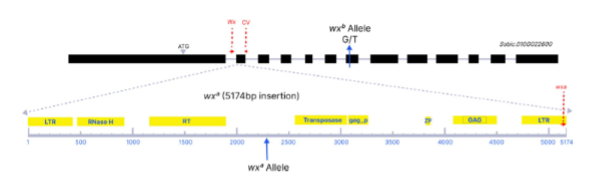
To overcome this, the researchers designed allele-specific PACE® assays that leverage the unique sequence differences between Wx, wxa, and wxb.
From the paper: We designed allele-specific PACE markers based on genetic variations between Wx, wxa, and wxb alleles. These PACE markers provided excellent discrimination of Wx, wxa, and wxb alleles. As the wxa allele includes a large insertion, we designed a common primer downstream of the insertion. The forward primer for wild-type (Wx) allele amplification is positioned upstream of the insertion while the forward primer for the wxa allele amplification is located at the end of the insertion. The expected amplicon sizes for PACE-PCR are 138 bp for Wx and 120 bp for wxa. Even though the forward primer for Wx can bind to the wxa DNA template in theory, the distance between the Wx and the common primer when the wxa insertion is present exceeds 5 kb, which is beyond the amplification range of PACE-PCR. This distinction enables differentiation between the two genotypes.
By developing a PACE® assay that cleanly distinguishes the wxainsertion alongside the more conventional wxb SNP allele, researchers demonstrated the versatility of the platform. PACE® can reliably genotype both SNPs and large InDels, giving breeders a practical way to track all major functional Waxy alleles in diverse germplasm. This capability not only accelerates waxy sorghum improvement but also highlights the broader potential of PACE® for crops where structural variants play an important role in trait expression.

A stronger foundation for genomics-assisted breeding
This new molecular toolkit gives breeders a more complete and efficient way to integrate the waxy trait into high-yielding commercial sorghum hybrids.
Market impact
The implications of this research are clear:
- Faster product development: Breeders can now move promising waxy lines through the pipeline with confidence, reducing time and cost.
- Expanded commercial use: Reliable PACE® markers unlock opportunities in brewing, baking, biofuels, and feed markets where quality traits are critical.
- Climate resilience: Waxy sorghum offers a viable alternative to barley and maize in regions affected by heat and drought, supporting more sustainable agricultural systems.
PACE®: Making science affordable
This study demonstrates why leading academic, public and private breeding programs turn to PACE®: it delivers accuracy, throughput and affordability in one platform. By replacing costly, time-consuming assays, PACE® makes advanced molecular breeding accessible to programs of all sizes.
At 3CR, our mission is simple: Making science affordable. With PACE® now validated as a powerful tool for specialty trait breeding in crops like sorghum, we are proud to support researchers and companies working to deliver the next generation of climate-smart, value-added crops to global markets.
Access the full paper here.
Reference: Yerka, M.K., Liu, Z., Bean, S., Nigam, D., Hayes, C., Druetto, D., Krishnamoorthy, G., Meiwes, S., Cucit, G., Patil, G.B. and Jiao, Y., 2025. An updated molecular toolkit for genomics-assisted breeding of waxy sorghum [Sorghum bicolor (L.) Moench]. Journal of Applied Genetics, pp.1-15.