A recent genome-wide association study (GWAS) on avocado skin colour has identified a key genomic region controlling pigmentation.
By combining high-density genotyping with multi-location phenotypic data, the study not only advances understanding of trait genetics but also highlights a clear pathway from discovery to application, an increasingly critical requirement in modern crop improvement programmes.
Why Avocado Skin Colour Matters in Breeding

Skin colour is a commercially important trait in avocado, influencing:
- Consumer preference
- Market segmentation (e.g. green vs purple varieties)
- Harvest timing and maturity assessment
Despite its importance, the genetic basis of this trait has remained poorly understood, with no widely adopted molecular markers available for selection.
Identifying the Genetic Drivers of Pigmentation
Using a robust GWAS approach with a mixed linear model (accounting for population structure and kinship), researchers analysed diverse avocado germplasm to uncover trait-associated variants.
The study identified a highly significant 220.93 kb region on chromosome CM056810.1, containing:
- 69 significant genetic variants
- 40 SNPs
- 29 indels
- 13 annotated genes
This region represents a major breakthrough in understanding the genetic architecture of avocado skin colour.
MYB Transcription Factors and Anthocyanin Biosynthesis
Within the identified region, five MYB transcription factors were discovered, including PAP1 and PAP2—key regulators of anthocyanin biosynthesis, the pathway responsible for pigmentation in plants.
Multiple lines of evidence supported their biological relevance:
- Comparative genomics revealed conserved homologs and duplication events, suggesting functional redundancy
- Gene Ontology enrichment showed strong association with anthocyanin pathways
- Phylogenetic analysis placed these genes in subgroup 6, linked to pigmentation control
Network analysis further identified PAP1 as a central regulatory hub, interacting with bHLH and WD40 proteins to form the MBW complex—a well-characterised system controlling pigment production in response to developmental and environmental signals.

Together, these findings position PaPAP1 as a key candidate gene controlling avocado skin colour.
From GWAS Discovery to Breeding Application
A major strength of this study is the successful translation of genomic insight into practical breeding tools.
Researchers developed PCR-based allele competitive extension (PACE®) markers targeting the most significant SNPs within the identified region. These markers were validated across avocado varieties with contrasting skin phenotypes and tested in multiple environments.
The results demonstrated:
- Strong and reliable genotype–phenotype association
- Consistent performance across locations
- Suitability for early-stage selection in breeding programmes
This enables breeders to move from phenotype-based selection to precision, DNA-informed decision-making.
Why PACE® Genotyping Was Critical
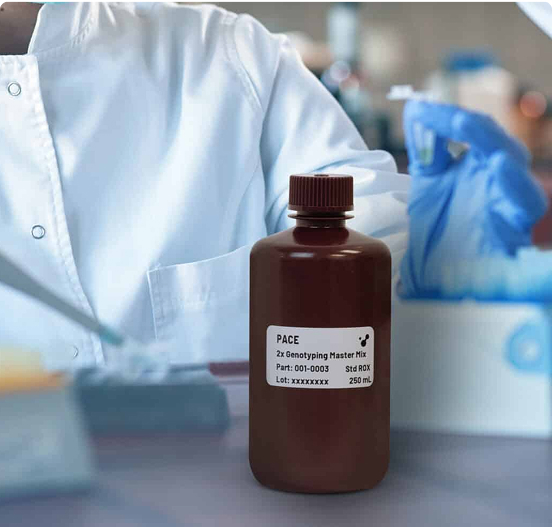
The study highlights the value of PACE® (PCR Allele Competitive Extension) genotyping as a scalable solution for SNP and indel analysis in crop genetics.

In this application, PACE® enabled:
- Cost-effective SNP genotyping without the need for labelled probes
- Rapid and flexible assay design for marker development
- High-throughput screening of breeding populations
- Reliable allele discrimination across diverse genetic backgrounds
By simplifying assay design and reducing costs, PACE® makes it easier to convert GWAS findings into usable molecular markers—bridging a gap that often slows breeding innovation.
Accelerating Marker-Assisted Breeding with 3CR Bioscience
This study reinforces the role of PACE® genotyping in enabling modern molecular breeding workflows.
Unlike probe-based technologies, PACE® requires only unlabelled primers—significantly lowering assay costs while maintaining high performance. The chemistry is fully compatible with standard PCR instrumentation and supports both SNP and indel genotyping at scale.
PACE assays allow:
3CR Bioscience further supports researchers and breeders by offering:
- Free PACE® assay design (with mastermix purchase)
- Fast turnaround from marker discovery to deployment
- Compatibility with existing workflows, including KASP™ and Amplifluor® assays
- Robust performance across agriculture, horticulture and aquaculture species
Making science affordable is central to this approach—ensuring advanced genotyping is accessible across breeding programmes of all sizes.

Implications for Avocado Breeding

The identification of PaPAP1 and the development of validated molecular markers provide a direct route to improved breeding efficiency.
Breeders can now:
- Select for skin colour at the seedling stage
- Increase consistency of marketable traits
- Reduce time and cost in breeding pipelines
- Integrate molecular selection into existing programmes
For a trait so closely tied to market value, this represents a significant step forward.
Conclusion: From Discovery to Deployment
This GWAS study demonstrates more than just a genetic insight—it showcases a complete workflow from variant discovery to validated, field-ready markers.
By combining genomic analysis with PACE® genotyping, researchers were able to rapidly translate data into actionable breeding tools. This approach is increasingly essential as breeding programmes seek to accelerate timelines, reduce costs, and improve precision.
As demand grows for efficient, scalable genotyping solutions, platforms like PACE® are playing a central role in advancing marker-assisted breeding and driving genetic improvement across economically important crops.
Looking to Develop Your Own Molecular Markers?
PACE® genotyping offers a fast, flexible, and cost-effective route from SNP discovery to validated assays.
Get in touch with 3CR Bioscience to learn how PACE® can support your marker development and breeding programmes
Reference
- Khan, Adil, et al. “Genome Wide Association Study and Molecular Marker Development of an Anthocyanin-Related Locus Underlying the Avocado (Persea americana) Skin Color.” Scientia Horticulturae, 2026, https://doi.org/10.1016/j.scienta.2026.114813.