Empowering Global Efforts in Sustainability and Diversity with SNP Genotyping
There is a wide diversity of animal genetic resources available for genomics and breed improvement programs. Researchers and breeders worldwide are now working to investigate and ensure the sustainable contribution of livestock to world food security and nutrition. Molecular techniques have developed rapidly, and the livestock sector has been an active participant in the genomic revolution. Advances in genome sequencing and genotyping methods, in particular SNP genotyping, have created opportunities for gathering more information on the molecular level than ever possible, faster and at exponentially decreasing costs. The decreased costs of genomic applications are now creating opportunities in countries with developing and transitional economies. Raising awareness of these opportunities like this blog will maximise accessibility to the full application of genomic tools. The aim is to improve the sustainable use and conservation of livestock genetic diversity.

Genomic Tools for Advancing Animal Health, Breeding, and Conservation
Genomics tools have emerged as invaluable assets in animal research and breeding. These tools encompass a range of molecular techniques, including SNP genotyping through methodologies like microarrays, GBS (Genotyping by Sequencing), and WGS (Whole Genome Sequencing). Their applications are diverse and impactful, enabling the assessment of genomic variation within populations.
Techniques like GWAS (Genome-Wide Association Studies) and haplotype analysis offer insights into the genetic basis of a wide range of traits.
Why SNP Genotyping?
SNPs, or Single Nucleotide Polymorphisms, are the predominant from of genetic variation, occurring at a frequency of 1 SNP per kilobase in most mammalian genomes. Their stable inheritance, high-density distribution, and ease of detection makes them the most suitable candidates for high throughput genotyping.
Allele-specific PCR with PACE
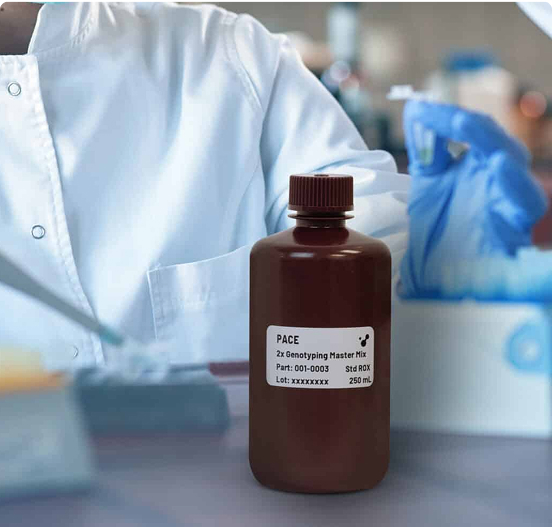
Alelle-specific PCR and SNP genotyping, and Indel genotyping with 3CR bio’s PACE reagents is ideal for breeding programs undertaking marker validation, genomic selection and marker-assisted selection. Allele-specific PCR with PACE genotyping reagents is widely used to identify and select animals with desirable traits. Accurate tracking of SNPs and Indels associated with traits such as disease resistance, productivity, or reproductive performance allows breeders to make informed decisions for breeding pair selection. PACE genotyping can be used to genotyping large numbers of animals quickly and accurately with identified allelic variants to study genetic relationships, evolutionary history, and patterns of genetic variation within and across animal populations. Allele-specific PCR lends itself perfectly to generate rapid, precise data for conservation efforts, to understand species evolution and design breeding strategies. In addition, efficient genotyping workflows can be integrated for veterinary genetic studies and diagnostics to help identify genetic disorders and determine the risk to animals.
3CR Bioscience’s Technology Leading Products for SNP Genotyping:
- PACE Genotyping Master Mix: A universal PCR mix for allele-specific PCR assays. Precision fluorescent signal generation with consistently high performance at any reaction volume.
- PACE 2.0 Genotyping Master Mix: Improved signal to noise ratio and tighter clustering compared, plus follow reactions in real time. Developed for crude DNA samples.
- PACE OneStep RT PCR Master Mix: Genotype directly from RNA samples. RNA Reverse transcription & cDNA PCR genotyping simultaneously in a single, one step reaction.
- ProbeSure Master Mix: Hydrolysis probe master mix for use with 5’ nuclease assays such as TaqMan™. Accurate, robust performance at competitive prices.
- Free assay design service:Develop allele-specific assays as breeder-friendly markers rapidly from genomic variants like SNPs and Indels for use with all PACE Genotyping Master Mixes. Full- and partial assay validation also available from our science team.
Harnessing the Power of Genetic Diversity with PACE PCR Genotyping
PACE PCR genotyping accelerates your genomic research and breed improvement programs. Read how PACE users apply genomic tools in livestock breeding to maximise animal health and longevity:
A reverse genetic screen method to investigate lamb mortality in French Dairy Sheep
Early, rapid sex-linked markers for Colossoma macropomum, the Amazon Tambaqui
Highlights from the 31st Plant and Animal Genome Conference :
Addressing Climate Change and Breeding Climate Resilient Livestock
The impact of climate change on agriculture encompasses many challenges such as extreme temperatures, drought, and shifts in pathogen distribution. These factors significantly affect food security and animal farming worldwide, across different economic backgrounds. A better understanding of how animals genetically and physiologically respond to climate change is crucial for effective strategies to mitigate its adverse effects. Pangenome analysis, genomic selection, PCR genotyping, transcriptomics, and genome editing all play vital roles in this endeavour, in breeding animals with greater resilience to climate change, and adopting innovative management techniques. By identifying and breeding livestock better suited to these evolving conditions, we can enhance productivity, minimize ecological impacts and reduce mortality rates in animal populations.
More about PAG
Genomics of Animal Health
Genomic advancements hold the potential for enhancing animal well-being by improving their health. The health of livestock is a primary concern, not only for maintaining animal welfare but also for preventing economic losses. The globalisation of the livestock sector adds international significance. Efforts to combat diseases in animals have traditionally focused on phenotypic diagnosis, prevention, treatment, and eradication. Vaccines and antibodies have typically been the primary tools used. However, pathogens often evolve more rapidly than vaccines can adapt reducing their effectiveness. Moreover, the widespread use of antibiotics has contributed to the emergence of antimicrobial resistance in many countries. There is considerable pressure to explore alternative methods for disease control in animals to ensure the industry’s sustainability. Genomic tools such as SNP discovery and validation with SNP genotyping provide a well-demonstrated avenue for improving animal health and longevity as well as agriculturally important traits such as nutrition. Research efforts are underway to identify genetic factors in livestock that contribute to disease susceptibility and resistance with the aim of reducing disease incidence and strengthening breeding populations.
More about PAG