Genome editing technologies, particularly CRISPR/Cas systems, have revolutionised genetic research by enabling precise modifications of genes, regulatory sequences, untranslated regions, and intergenic regions. These tools are increasingly being adopted for plant breeding to improve crop varieties and for cell line development in life sciences. Alongside CRISPR, tools like TALENs remain valuable, offering diverse approaches to genome modification.
Despite the transformative potential of these technologies, a significant challenge lies in efficiently identifying successful edits within a population. The current reliance on high-throughput sequencing (HTS) for screening can be time-consuming, expensive, and data-intensive. High-throughput CRISPR genotyping solves this bottleneck by confirming which samples carry the intended edit before any costly sequencing is performed. PACE® (PCR Allele Competitive Extension) genotyping provides a cost-effective, scalable, and rapid alternative for primary screening of genome edits, applicable to both agricultural and life sciences research. For a complementary overview of PCR-based screening, see 3CR Bioscience’s guide to high-throughput PCR for CRISPR screening.
CRISPR and the Spectrum of Edits
CRISPR-mediated gene editing can generate a range of modifications, including:
- Single base-pair changes
- Frameshifts
- Gene knockouts
- Small and large insertions or deletions.
These edits occur through either Non-Homologous End Joining (NHEJ), which introduces random mutations at the double-strand break site, or Homology-Directed Repair (HDR), which uses a template DNA strand for precise changes. Because each repair event can produce a different sequence outcome, identifying successful edits across populations requires efficient, high-throughput screening tools that can distinguish edited from wild-type alleles.

Challenges of Sequencing for Screening
Traditional sequencing methods are often used to screen edited populations, but they present several drawbacks:
- High Costs: Sequencing is expensive, especially for large populations.
- Sample Purity Requirements: Sequencing demands high-purity DNA extractions, increasing preparation time and costs.
- Data Overload: Large datasets must be analysed to pinpoint successful edits, requiring computational resources and expertise.
- Turnaround time: Sequencing queues and analysis can delay breeding and cell-line decisions by days or weeks.
How to Screen CRISPR Edits: Comparing Genotyping Methods
CRISPR edits are screened by amplifying the target locus and then detecting whether the intended change is present, using allele-specific PCR, sequencing, mismatch-cleavage assays, or fragment-size analysis. The right method depends on the edit type, the number of samples, and whether off-target analysis is needed. The table below compares the most common approaches so researchers can match a method to each stage of a project.
| Method | Detects | Throughput | DNA quality | Relative cost | Best use |
| PACE (allele-specific PCR) | SNPs, base edits, small & large indels, knockouts | Very high (96/384-well) | Crude lysates accepted | Low | Primary screening of known edits at scale |
| NGS / amplicon sequencing | All edits + off-target, <1% allele frequency | High (pooled) | High-purity DNA | High | Deep validation and off-target analysis |
| Sanger sequencing | All edits at a locus | Low to medium | High-purity DNA | Medium-high | Confirming exact sequence of positives |
| TIDE / TIDER | Indel spectra, HDR (TIDER) | Medium | Medium | Medium | Estimating editing efficiency in bulk |
| T7E1 / Surveyor | Mismatch-cleavage indels | Low | Medium | Low-medium | Quick yes/no on editing activity |
| Gel / restriction digest | Large indels, RE-site changes | Low-medium | Medium | Low | Visual screening of size or RE shifts |
In practice, most large projects combine methods: a fast, low-cost assay such as PACE genotyping pre-screens hundreds or thousands of samples, and sequencing is reserved for confirming the small number of positives. This tiered approach keeps sequencing volumes, and therefore costs, to a minimum.
PACE® Genotyping: A Cost-Effective Screening Solution
PACE allele-specific genotyping addresses these limitations by enabling rapid, precise, and scalable detection of genome edits. It uses competitive allele-specific primers and a universal fluorescent reporting system to distinguish edited alleles from wild-type sequences in a single PCR reaction, the same chemistry used for SNP genotyping and allele-specific PCR with PACE.

Key Benefits of PACE Genotyping
- Broad Applicability:
- Compatible with plants, animals, tissue cultures, protoplasts, seeds, and more.
- Efficiency:
- Detects a wide range of edits, including SNPs, knockouts, and both small and large Indels.
- Uses simple, unlabelled primers customised to specific target sequences. Real-time or endpoint reporting available.
- Cost-Effectiveness:
- Requires minimal DNA input and works with crude lysates and high-throughput extraction methods.
- Reduces the need for sequencing by pre-screening populations to identify desired edits.
- High Accuracy:
- Employs allele-specific primers to distinguish wild-type from edited sequences with precision.
- Versatility:
- Supports zygosity assays, detection in single cells/plants, and monitoring genetic changes throughout breeding.
- Enables screening in DNA-mediated and DNA-free editing processes.
- Ease of Use:
- Combines target amplification and fluorescence detection, eliminating any post-PCR processing.
- Tailored workflows simplify adoption for new users

Calculate Your Potential Savings
One customer reduced genotyping costs by 70–80% by switching to PACE. Our team can design and pre-validate custom assays for your specific edits.
PACE Genotyping: Assays for Every Type of Edit
Example 1: Gene Knockouts Using Non-Homologous End Joining
CRISPR induces double-strand breaks, leading to gene inactivation through NHEJ due to random small insertions or deletions. PACE assays can be designed to report the loss of the wild-type sequence, flagging knockout candidates without sequencing every sample.


Example 2: Single Base Edits Using Homology-Directed Repair
Base editing allows single nucleotide changes. It is used to correct point mutations or introduce single-base changes. Allele-specific primers can be designed to discriminate a single base difference, making PACE well suited to confirming precise base edits.
Example 3: Gene Knock-Ins Using Homology-Directed Repair
A precise DNA sequence is inserted at the target site using HDR. Used for correcting mutations or inserting new sequence elements such as tags, promoters, or selectable markers. PACE assays targeting the junction between the insert and the genome confirm correct, on-target integration.

Avoiding Allele Dropout in CRISPR Clone Genotyping
Allele dropout (ADO) occurs when one of the two alleles at a locus fails to amplify during PCR, so a heterozygous clone can be misread as homozygous. In CRISPR clone genotyping this is a common source of error, because indels at the cut site can disrupt a primer binding region and silence that allele. The result is a wrong zygosity call and, potentially, advancing the wrong line.
Allele-specific designs reduce this risk in two ways. First, running both an edit-specific and a wild-type reference assay on every sample reveals when an expected allele is missing rather than truly absent. Second, positioning primers away from variable indel regions and validating each assay against synthetic controls before screening helps ensure both alleles amplify reliably. 3CR Bioscience pre-validates PACE assays using synthetic controls for the edit and the wild-type sequence, which provides a built-in check against dropout. Guidance on primer placement is covered in 3CR Bioscience’s notes on SNP and indel genotyping assay designs.
Spotlight: Applications in Plant Breeding
CRISPR/Cas systems dominate plant breeding, enabling the development of crops with improved traits. PACE genotyping offers critical support at various stages of the breeding pipeline:
- Optimising Genome Editing: Detects edits early to refine transformation protocols.
- Bulk Screening: Tests bulk seed or grain populations for purity of edited traits.
- Regulatory Dossiers: Provides robust data for regulatory approval.
- Market Monitoring: Tracks edits in commercial products.

PACE can detect all classes of edits, from single nucleotide changes (SDN1) to large rearrangements (SDN3), plus monitor potential off-target modifications.
Where two edited regions must be followed at once, a multiplexed assay can report both in a single reaction, an approach described in 3CR Bioscience’s guide to multiplex SNP genotyping with PACE.
Example Workflow
- Assay Design: Submit the target sequence to 3CR Bioscience, including 100 bases upstream and downstream.
- Assay Delivery: Receive ready-to-use PACE assays, pre-validated using synthetic controls tailored to detect your specific edits or wild-type sequences.
- Reaction Setup:
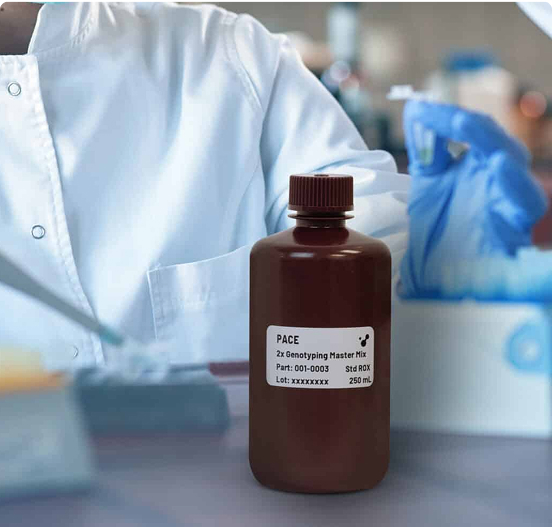
- Assemble the reaction using ready-to-use PACE Assays and PACE Genotyping Master Mix.
- Ensure proper plate layout with non-template controls and wild-type reference samples.
- Run and Analyze: Perform the PCR run, analyze fluorescence data, and identify edited samples.
- Follow-Up: Isolate positive samples for further characterization by sequencing, if required.
Case Study: CoverCress Inc.
CoverCress Inc. (CCI) is converting field pennycress into a new domesticated variety under the CoverCress® brand as the third crop in standard corn/soybean rotations. This could be used on up to 10 million acres at maturity in the US. To enable the domestication of field pennycress to CoverCress®, the company is using gene editing technology to deploy crucial genetic changes in advanced germplasm identified through breeding programs.

In the CCI product development pipeline, gene editing is used for trait discovery and integration, resulting in the editing of 30-50 unique germplasms with 3-5 gene targets and 2-3 lines with 30-50 unique gene targets every year. Genotyping is one of the major bottlenecks in the edit conversion process. Each DNA repair event can result in a unique DNA modification, limiting the utilization of allele-specific assays in the edit discovery process, and necessitating the use of Sanger sequencing for allele or edit discovery in the lines. While Sanger sequencing is considered the gold standard, its costs can add up significantly when dealing with large volumes of lines, and the turn-around time with Sanger sequencing can delay the decision-making process.
In collaboration with 3CR Bioscience, CCI developed and optimized CRISPR assays that demonstrated remarkable cost efficiencies. Implementing these assays into the pipeline has reduced the total genotyping costs of identifying one edit conversion by 70-80%. These savings highlight the potential for PACE to make gene editing projects not only more cost-effective but also more scalable for a wide range of applications, while reducing delays and limitations associated with Sanger-based genotyping platforms.
Application I: Gene Knockouts using Non-Homologous End Joining for Novel Discovery of Edits

Application II: Selection of Progenies in A Segregating Population with Two Unique Gene Edits using a multiplexed PACE CRISPR assay

Gene editing creates novel alleles in each transformation event, and the edited lines used in breeding programs can pose challenges in marker-assisted selection (MAS) due to the variety of alleles incorporated in the crossing designs. Through continued collaboration with 3CR Bioscience, CCI optimized these assays for use in their MAS program, identifying a pathway to multiplex two uniquely edited regions in the genome. In addition to cost savings, these PACE assays play a crucial role in streamlining marker selection with edited germplasm in any crop.
Frequently Asked Questions
How do you screen CRISPR edits?
CRISPR edits are screened by amplifying the edited locus and detecting whether the intended change is present. Fast, low-cost methods such as allele-specific PCR (PACE) are used to pre-screen large numbers of samples, and sequencing is then used to confirm the exact sequence of the positives. This keeps sequencing volumes, and costs, low.
What is high-throughput genotyping in CRISPR?
High-throughput genotyping is the rapid analysis of many samples in parallel, typically in 96- or 384-well plates, to identify which carry a specific genetic change. In CRISPR work it is used to find successful edits across large edited populations without sequencing every individual.
How does PACE genotyping compare to NGS and Sanger sequencing?
NGS and Sanger sequencing read the actual sequence and are ideal for confirmation and off-target analysis, but they are more expensive and slower at scale. PACE genotyping does not read sequence; it reports whether a known edit is present, at much lower cost and higher throughput. The most efficient pipelines use PACE for primary screening and reserve sequencing for confirming positives.
Can PACE genotyping detect off-target edits?
PACE assays can be designed against predicted off-target sites to monitor for unintended changes at known loci. For genome-wide, unbiased off-target discovery, sequencing-based methods remain the reference approach, and PACE is best used to track specific sites of concern at scale.
What is allele dropout in CRISPR clone genotyping?
Allele dropout is the failure of one allele to amplify during PCR, which can make a heterozygous clone look homozygous. Running paired edit-specific and wild-type reference assays and validating primers against synthetic controls helps detect and prevent dropout, leading to accurate zygosity calls.
What DNA quality does PACE genotyping require?
PACE genotyping works with minimal DNA input and tolerates crude lysates produced by high-throughput extraction methods, so high-purity DNA preparation is not required for primary screening. This is one of the main reasons it is faster and cheaper than sequencing-based screening.
Researchers planning a CRISPR screening project can have 3CR Bioscience design and pre-validate custom PACE assays for their specific edits, and run them with the PACE Genotyping Master Mix to cut sequencing costs while scaling to thousands of samples. Learn more about the PACE Genotyping Master Mix and 3CR Bioscience’s SNP genotyping assays and PCR platforms.
Ready to Reduce Your CRISPR Screening Costs?
Whether you’re screening knockouts, base edits, HDR knock-ins, or multiplex gene edits, our team can design and pre-validate custom PACE assays tailored to your project.
Conclusion
PACE allele-specific genotyping is a valuable tool for high-throughput gene editing workflows. By offering a cost-effective, precise, and scalable alternative to sequencing, it empowers researchers in both agriculture and life sciences to accelerate their genome editing projects. Whether optimising editing protocols, screening bulk populations, or preparing regulatory data, PACE genotyping is a critical component of the gene editing toolkit.