Blog

SNP Genotyping and High-Resolution Mapping of a Novel Hybrid Susceptibility Locus in Barley Using PACE® Genotyping Technology

SNP Genotyping and High-Resolution Mapping of a Novel Hybrid Susceptibility Locus in Barley Using PACE® Genotyping Technology

A new study by Clare et al. has made significant strides in understanding the genetic basis of disease susceptibility in hybrid barley. A collaboration between researchers in the USA and China, co-ordinated by Washington State University, has identified and mapped a novel hybrid susceptibility locus, named Susceptibility to Pyrenophora teres 2 (Spt2), which is exploited by the necrotrophic pathogen Pyrenophora teres f. maculata (Ptm). This pathogen causes spot form net blotch (SFNB), a disease that can lead to severe yield losses. The innovative use of PACE® (PCR Allele Competitive Extension) SNP genotyping technology was critical to the success of this high-resolution mapping effort.

Significance to Barley Breeders

Hybrid barley, known for its potential yield advantages due to heterosis, can sometimes exhibit increased susceptibility to diseases. This phenomenon was observed in crosses between resistant barley lines (CI5791, Tifang, and Golden Promise) where the F2 progeny displayed extreme susceptibility to Ptm. Understanding the genetic underpinnings of this susceptibility is crucial for barley breeders aiming to develop resistant hybrid varieties. The discovery of the Spt2 locus offers valuable insights that can guide breeding strategies to avoid the release of hybrids with deleterious disease susceptibility traits.

Dr Shaun Clare, Lab Manager of the Barley Breeding and Molecular Genetics Lab at Washington State University, explains further: “Since the majority of barley production is not as a hybrid crop, this may seem like insignificant research. However, since we believe the molecular mechanisms underlying this hybrid susceptibility will also be relevant to the molecular control of hybrid vigor, we believe this will serve as an excellent model to really tease apart these complex genetic interactions”
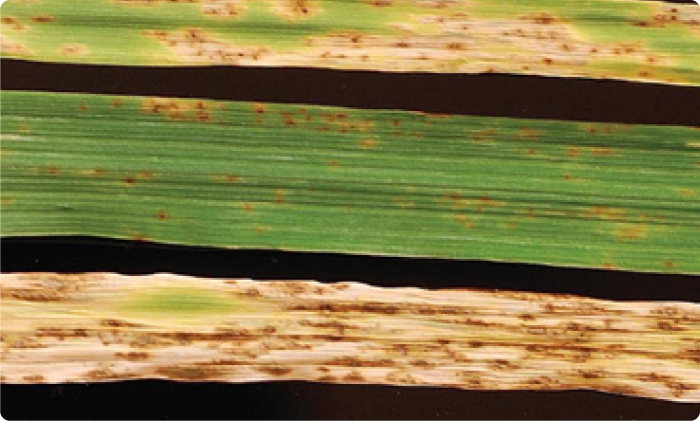
Phenotypic results of parental and hybrid barley. Parents C15791 (top), and Tifang (middle) and C15791 x Tifang F1 after one week post inculation with Pyrenophora teres f. maculata isolate 13IM8.3. From Clare et al. 2024.

PACE® Genotyping Technology

PACE genotyping played a key role in this research. It enabled the identification and mapping of genetic polymorphisms between different barley lines. By targeting specific polymorphisms, the researchers could precisely map the Spt2 locus to a 198 kb region on chromosome 5H. This high level of resolution was essential for identifying the candidate gene within the Spt2 locus, predicted to encode a pentatricopeptide repeat-containing protein (PPR).

Dr Clare continues, “Despite the rapid improvement in accuracy and cost of sequencing, sequencing all of our critical recombinants still would not be feasible. Converting polymorphisms identified through genomic comparison of the parental lines to PACE genotyping assays allowed us to really narrow down the final recombination points and delimit this locus to a single candidate gene”

Research Findings

The study involved comprehensive genetic mapping using F2 populations from CI5791 × Tifang and CI5791 × Golden Promise crosses. The susceptible phenotype segregated in a 1:1 ratio of resistant to susceptible individuals, indicating a single hybrid susceptibility locus. The mapping of Spt2 was independently validated in two different populations, strengthening the confidence in the results. Comparative genomic analysis between CI5791 and Golden Promise further supported the identification of a single candidate gene within the Spt2 locus.

Implications and Future Directions

The identification of the Spt2 locus and its candidate gene opens new avenues for research and breeding. Understanding how this gene contributes to hybrid susceptibility can help in developing strategies to mitigate this risk. Additionally, this study underscores the importance of considering hybrid susceptibility in breeding programs, especially for crops like barley, where hybrid varieties are increasingly being adopted.

Future research will focus on characterizing the Spt2 gene and its function in the context of hybrid susceptibility. Reverse genetic approaches, such as loss-of-function and knockdown studies, will be essential to validate the role of the PPR gene in disease susceptibility. Furthermore, exploring the genetic and epigenetic mechanisms underlying this susceptibility could provide deeper insights into how heterosis and hybrid vigor can be optimized without compromising disease resistance.

Conclusion

The work by Clare et al. highlights the innovative use of PACE genotyping technology for SNP genotyping to achieve high-resolution mapping of a novel hybrid susceptibility locus in barley. The study not only advances our understanding of hybrid susceptibility but also sets the stage for future research aimed at enhancing the resilience of barley crops to disease.

Reference

Clare, S.J., Alhashel, A.F., Li, M. et al. High resolution mapping of a novel non-transgressive hybrid susceptibility locus in barley exploited by P. teres f. maculataBMC Plant Biol 24, 622 (2024).

MORE POSTS

Automated Pipetting vs. Manual Pipetting: Which Is Right for Your Lab?
Discover when manual pipetting is enough—and why automated pipetting with 3CR’s GeneArrayer and PACE® genotyping delivers superior speed, accuracy, and scalability.
High-Throughput PCR in CRISPR Screening and Genome Editing Verification
Discover how high-throughput PCR using PACE® genotyping accelerates CRISPR screening and genome editing verification across large sample populations.
Understanding the genetics of important traits in hemp to help breed improved cultivars
Learn how Cornell University uses PACE® SNP genotyping to accelerate hemp breeding—enabling early trait selection, sex determination, and cost-effective genetic screening.

Our product portfolio for your PCR genotyping workflow

Our portfolio of products and services include PACE® genotyping chemistry, instruments, and lab services to streamline every step of your workflow. Designed for life sciences, biotech, and agricultural research, our high-performance reagents, reliable instruments, and expert lab support help you achieve accurate, consistent results while reducing time and costs – making science affordable.

[fibosearch]
This field is for validation purposes and should be left unchanged.
Name(Required)

Contact us

Stay up to date with all things 3CR. 

Sign up now to receive insights, updates 
and industry case studies. 

This field is for validation purposes and should be left unchanged.
Name(Required)

MEET OUR TEAM

Steve AsquithManaging Director
Steve began his career in the Genetics Division of GlaxoSmithKline, as part of the team establishing GSK’s high-throughput core genotyping laboratory. Steve joined KBioscience when it was first founded in 2002 and was a key driver in taking the company from a small start-up to a multi-national service laboratory, quickly growing the company’s revenue to over $7.5M p.a. Following the acquisition of Kbioscience by LGC in 2011, Steve was appointed Global Director of Operations for LGC Genomics, responsible for over 100 staff in Europe and N. America, successfully elevating the genotyping products and service business. Steve held a crucial leadership role until he left in 2016. In 2017 Steve joined forces with John Holme to create 3CR Bioscience, a new company with a mission to deliver outstanding, customer-focused genotyping products with innovation and affordability at its core.
Dr. John HolmeTechnical Director

John joined KBioscience shortly after it was founded, in 2003, and became Head of Technical Development, building the company’s genotyping and DNA extraction product portfolio and service delivery until 2011 when it was acquired by LGC. Post-acquisition, John was appointed Head of Technical Group for LGC Genomics, in charge of all Research & Development and Technical Support activities for the company. In this role John continued to build on the high-quality products and services provided to the companies growing customer base.

During the 19 years John has worked in commercial R&D, he has co-invented numerous highly successful products including PACE®, ProbeSure, KASP™, KlearKall, KlearGene, KlearAmp and KlearTaq™, creating breakthrough offerings in genotyping and extraction and generating huge revenues for the companies he has worked in. In 2017, he joined forces with Steve Asquith and started 3CR Bioscience. John is dedicated to developing outstanding, innovative genotyping products and providing the very best technical support to customers globally.

Dr. Nisha JainOperations Director

Nisha has been innovating since the start of her career at Geneform Technologies developing Iso-thermal Genotyping Technologies. Nisha joined KBioscience in 2008, as Senior R&D Scientist and key account Technical Support Scientist, developing KASP and Klearkall performance and coinventing two further versions of KASP.

Nisha has more than 15 years’ experience working in molecular biology and genotyping technologies, with extensive experience in the areas of R&D, Quality Assurance and Customer Technical Support. She has technically assisted many giants of the industry with their protocol development and troubleshooting and continues to deliver high-quality support and guidance. In 2018, Nisha joined 3CR Bioscience as Operations Director where she continues to develop PACE and ProbeSure for an increasing range of applications, and to grow 3CR Bioscience’s new product pipeline. Nisha is dedicated to developing outstanding, innovative genotyping products and providing the very best technical support to customers globally.

Nazma SaffinGeneral Manager
For 20 years Nazma Saffin has worked and gained extensive expertise within the genotyping sector. Working at Kbioscience and then LGC, she has held operational leadership posts responsible for manufacturing and laboratory services. With experience of ISO 9001 implementation, production scale up and LEAN operations, Nazma has successfully led highly profitable production departments. Joining 3CR Bioscience in 2022, Nazma is committed to delivering operational excellence.
Greig PollandAutomation and Support Manager

Greig is a hands-on automation specialist and team leader with a strong background in laboratory and industrial automation. He has spent over 25 years developing, installing, and supporting automated systems that transformed laboratory workflows. During this time, Greig worked closely with scientists and engineers to tailor automation solutions for genotyping and molecular biology, an experience that sparked his lasting passion for combining technology with practical science.

Since then, Greig has built on that foundation through leadership roles where he leads automation and support operations. He’s known for being approachable, commercially minded, and deeply committed to helping teams and customers get the best from their technology.

Whether managing a complex automation rollout or helping a customer troubleshoot in real time, Greig brings a thoughtful, collaborative approach that keeps people ,not just machines, at the centre of what he does.