In this tech note we guide you through the 5 top assay designs for SNP and Indel genotyping, with suggestions for optimising your assay primers, and answers to some common FAQs. First, we will review the basics of Allele-Specific PCR and 3CR Bio’s patented PACE® genotyping chemistry.
Allele-specific PCR (AS-PCR) is a widely used molecular biology technique for the genotyping of specific alleles within a population. With advancements in PCR technology, allele-specific genotyping assays have become indispensable tools for high-throughput, accurate detection of Single Nucleotide Polymorphisms (SNPs) and insertions/deletions (Indels) in DNA samples.
PACE® is 3CR Bioscience’s patented genotyping chemistry tailored for Allele-Specific PCR genotyping. It is based on a polymerase chain reaction (PCR) with two competing allele-specific primers and a common reverse primer, coupled with an endpoint fluorescent measurement. PACE uses a novel, universal, fluorescent reporting cassette to produce machine-readable fluorescent signals corresponding to the genotypes. A video illustrating Allele-Specific PCR and the PACE reaction mechanism can be found here.

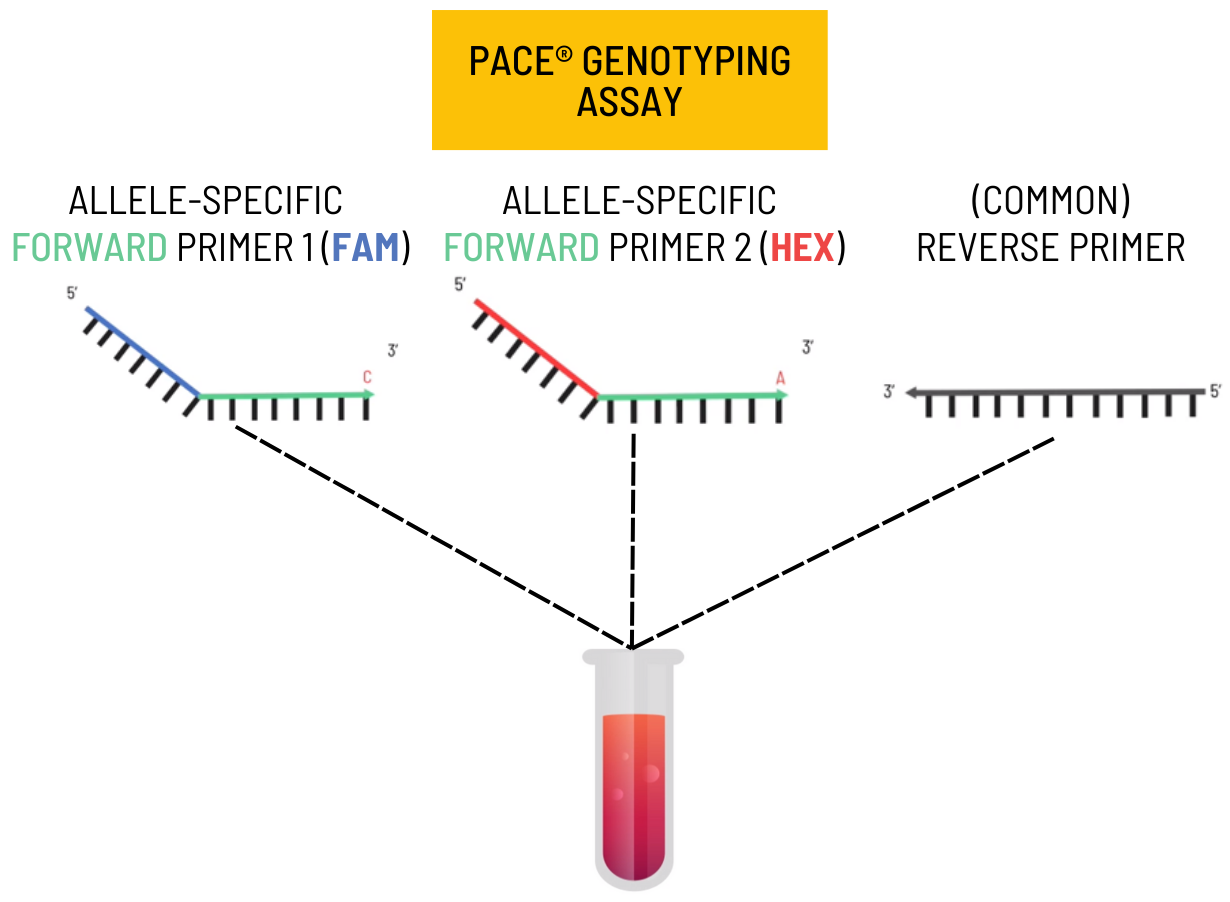
A PACE genotyping reaction is comprised of two parts, a custom PACE Genotyping Assay and PACE Genotyping Master Mix. When combined with template DNA, these components create the PACE genotyping reaction.
The PACE chemistry mechanism of action is as follows: when PCR is initiated, the allele-specific primers bind with their 3’ ends at the SNP or Indel of interest. Both allele-specific primers will bind if the SNP or Indel is heterozygous, but only one or the other of the primers will bind if the SNP is homozygous. At the same time, the common reverse primer will bind on the opposite strand immediately downstream of the SNP or Indel. As PCR proceeds, the target is amplified and at the same time the reporter-tail sequences of the allele-specific forward primers become incorporated into the amplicon, and the corresponding reporter-tail complement is generated.
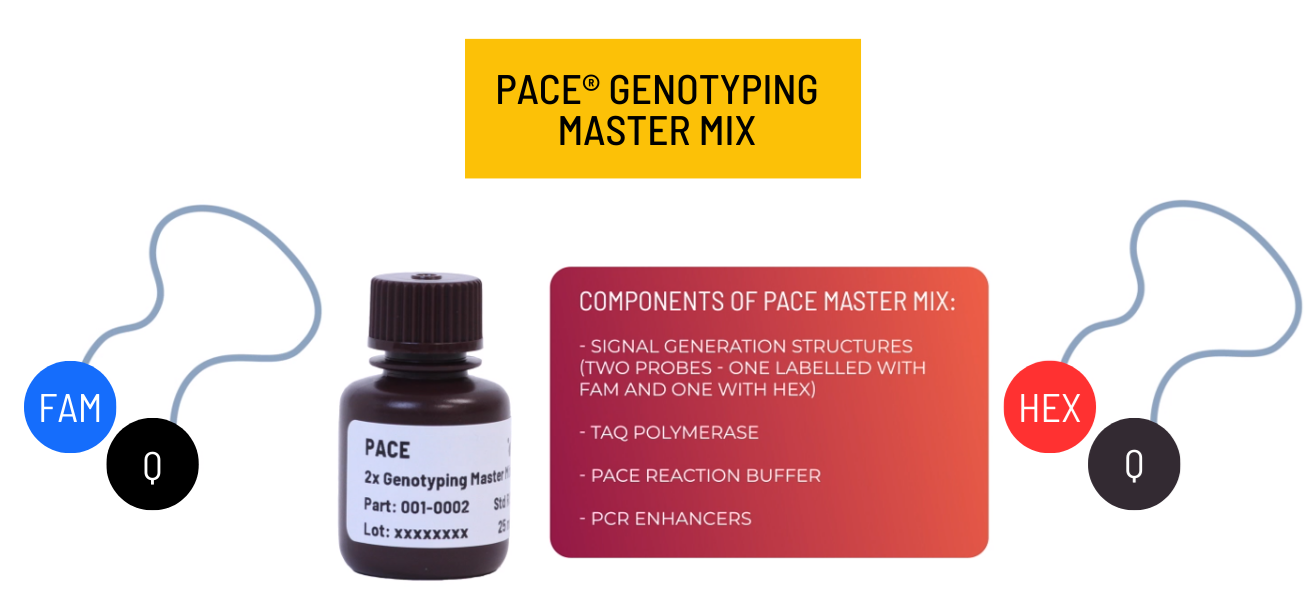
At this point, the quenched, fluorescent reporting cassettes in the PACE Genotyping Master Mix bind to their appropriate reporter-tail sequence complements, and as they unfold become unquenched and emit a fluorescent signal. If the genotype of the target SNP is homozygous, only one of the two fluorescent signals (FAM or HEX) will be generated, and if the SNP is heterozygous, both fluorescent signals will be emitted and a mixed fluorescent signal generated. The signal can be detected either on a qPCR machine or with a fluorescent plate reader (see Figure 4).

SNP and Indel Genotyping Assay Designs
SNPs are codominant markers and are highly abundant across the genome. Because of this, they are regularly used for various genetic analyses, including studies on genetic diversity and population structure, linkage mapping, quantitative trait loci (QTL) mapping, genome-wide association studies (GWAS), marker-assisted selection (MAS), and genomic selection. Indels involve the insertion or deletion of nucleotides in a DNA sequence. Indels are valuable markers for studying genetic diversity, population genetics, disease association studies, and marker-assisted selection of desirable traits.
Top 5 SNP and Indel Assay Designs
PACE Genotyping Assays can be designed to discern a wide range of different DNA sequence variants in a population, including:
- Biallelic SNPs
- Single-base Indels
- Small Indels
- Large Indels with known junctions
- Large Indels without known junctions
PACE Multiplex Master Mix offers even more options with up to four targets per reaction, including:
- Two biallelic SNPs in one reaction
- 3 and 4-allele SNPs
- Three target genes + reference/housekeeping gene


Did you know?
Customers who have purchased any PACE master mix within the last 24 months can use 3CR Bioscience’s free PACE Assay design service. Simply submit your SNP/Indel of interest with flanking sequence and our scientific team will use 3CR’s optimised design software to design assays for your target sequences and send you the optimised primer design sequences allowing you to order from your chosen oligo manufacturer. We also offer full- or partial assay validation options. For further information, see our dedicated assay design webpage here.

Practical Considerations and Recommendations for Assay Design
1. Successful assay design depends upon the quality of sequence information. Ideally, having at least 50 nucleotides upstream and downstream from the target SNP site is optimal for primer design. In some cases, primer design can be successful with fewer nucleotides.
2. Any unidentified polymorphisms near the targeted SNP or Indel of interest can potentially hinder the functionality of a PACE genotyping assay. The more information available on any neighbouring SNPs, the more optimal the design.
3. Understanding homology in the genome, if known, is valuable. Any presence of the targeted SNP elsewhere in the genome may skew the data. If homology is identified, discerning any bases unique to the SNP of interest nearby will anchor the assay to the correct SNP and boost its performance.
Here are some answers to commonly asked assay design questions:
DO I NEED TO OPTIMISE PACE CYCLING CONDITIONS FOR DIFFERENT ASSAYS?
Most assays will perform well with the standard cycling conditions listed in the user guides. There are some exceptions, such as assays with a very high GC content or concerns about homology. If you encounter issues with cycling conditions for challenging assays, please contact our Technical Support team. We have extensive experience in optimising assay designs for complex situations.
HOW DO I SUBMIT MY SEQUENCES FOR THE FREE PACE ASSAY DESIGN SERVICE?
To request your PACE assay design, fill out the PACE assay design template and email It directly to 3CR Bioscience at support@3crbio.com. Any customer who has purchased any PACE master mix within the last 24 months is eligible for 3CR Bioscience’s free PACE Assay design service.
CAN I USE PACE FOR PRESENCE/ABSENCE OR ADVENTITIOUS PRESENCE ASSAYS?
Yes, you can use PACE for these applications. The assays designed for these purposes are not competitive and do not follow the standard genotyping assay model. Instead, we design one assay composed of a (5’ tailed) forward primer and a reverse primer for detecting one sequence, and another assay of the same type for detecting the other sequence. The two assays report using different fluorophores (FAM and HEX).
HOW LONG DOES IT TAKE TO DESIGN AND VALIDATE A PACE GENOTYPING ASSAY?
We guarantee a 24-hour turnaround on assay designs. Additionally, we offer full or partial validation services where we order and validate your assays before shipment, which may take longer based on the project’s size and complexity. Our typical turnaround time for validated assays is 2-4 weeks after receiving the DNA samples
Advanced Techniques and Emerging Trends
Beyond straightforward SNP and Indel detection, PACE assays can also be adapted for other applications such as pathogen detection and the detection of transgenic sequences. Our tailored reaction mixes accommodate both endpoint and real-time detection, from DNA or RNA (PACE OneStep RT-PCR Master Mix). PACE master mixes are compatible with all major PCR genotyping platforms, including 96-, 384-, 1536- well PCR plates, as well as Array Tape®, producing accurate data regardless of the reaction volume. Whether exploring new avenues in genotyping or embarking on a unique research endeavour we welcome the opportunity to collaborate and support your projects. Please contact us at support@3crbio.com for enquiries or support requests.
Reference:
- PACE Genotyping Master Mix User Guide.
- von Maydell, D. (2023). PCR Allele Competitive Extension (PACE). In Plant Genotyping: Methods and Protocols (pp. 263-271). New York, NY: Springer US.